In 2009, Domino’s Pizza was in genuine crisis. Two employees in North Carolina filmed themselves doing unspeakable things to food they were about to deliver and posted the video to YouTube. It went viral. Within 48 hours, over a million people had watched it.
The stock was already at $3. The brand was already being mocked for its food quality. And now there was video evidence of the internal culture. Domino’s had a choice: defend, deflect, or do something that almost no large public company had ever done before.
They chose the third option. They told the truth.
The Crisis Before the Campaign
The 2009 viral video was not the origin of Domino’s problems: it was the match that ignited the gasoline that had been pooling for years. Consumer surveys from that period showed that Domino’s ranked last among major pizza chains in taste. Not competitive but slightly behind. Last.
The brand had built its identity around speed. “30 minutes or it’s free” was a legendary positioning that had worked in the 1980s. By 2008, that positioning had calcified into a brand promise of: fast pizza, mediocre food. Customers were not surprised when the pizza was bad. They expected it.
CEO Patrick Doyle inherited this situation and made a decision that most corporate boards would have rejected outright. He was going to put the customer criticism on camera, acknowledge it word for word, and announce that they had rebuilt the entire recipe from scratch.
The “Our Pizza Sucks” Campaign: What Actually Happened
In December 2009, Domino’s launched what is now one of the most-studied advertising campaigns in modern business history. The TV spots showed real Domino’s executives reading real customer feedback. Verbatim. On camera.
The quotes were brutal: “Domino’s pizza crust, to me, is like cardboard.” “The sauce tastes like ketchup.” “Worst excuse for pizza I ever had.”
The executives did not get defensive. They sat with the feedback, acknowledged it directly, and then revealed that the company had spent 18 months working with chefs and food scientists to overhaul the entire recipe. New crust. New sauce. New cheese blend. Everything changed.
This was not a PR move dressed up as honesty. It was honesty backed by real action. The distinction matters enormously because consumers can detect the difference. Vulnerability without substance is just manipulation. Domino’s paired the admission with evidence: here is what we changed, and we are putting it in front of you to judge.
Radical honesty: a brand strategy in which a company publicly acknowledges its own failures or weaknesses, then demonstrates concrete change. It works when the admission is genuine and the follow-through is real. It fails when it is theater.
The Sales Response Was Immediate
In Q1 2010, the quarter after the new recipe and campaign launched, Domino’s posted same-store sales growth of 14.3%. That is not a typo. In an industry where 3-4% growth is considered strong, Domino’s nearly quadrupled the benchmark in a single quarter.
The broader market was still recovering from the 2008 financial crisis. Restaurant category growth was flat. Domino’s had done something that defied the logic of its competitive environment: it grew faster by admitting it had been worse.
By 2012, the stock had climbed from $3 to over $30. The recipe overhaul was a success. But what came next was the real transformation.
The Tech Pivot: “We Are a Tech Company That Happens to Sell Pizza”
Patrick Doyle began saying something publicly around 2012 that sounded strange coming from a pizza chain CEO: Domino’s was a technology company that happened to make pizza.
This was not positioning spin. He meant it operationally. Domino’s began investing in technology infrastructure at a pace that outpaced most pizza competitors by an order of magnitude. They built a dedicated tech team, acquired data engineering talent, and started treating digital ordering not as a feature but as the core business.
The results:
- The Domino’s Tracker launched in 2008 and became the industry’s first real-time order tracking tool
- By 2014, digital sales exceeded 50% of total US revenue
- The AnyWare platform, launched in 2015, allowed customers to order via tweet, text, smartwatch, Ford Sync, Amazon Echo, smart TV, and eventually 15+ platforms
- By 2018, digital sales represented over 65% of all US orders
- Domino’s built an AI-powered delivery routing system that reduced average delivery times
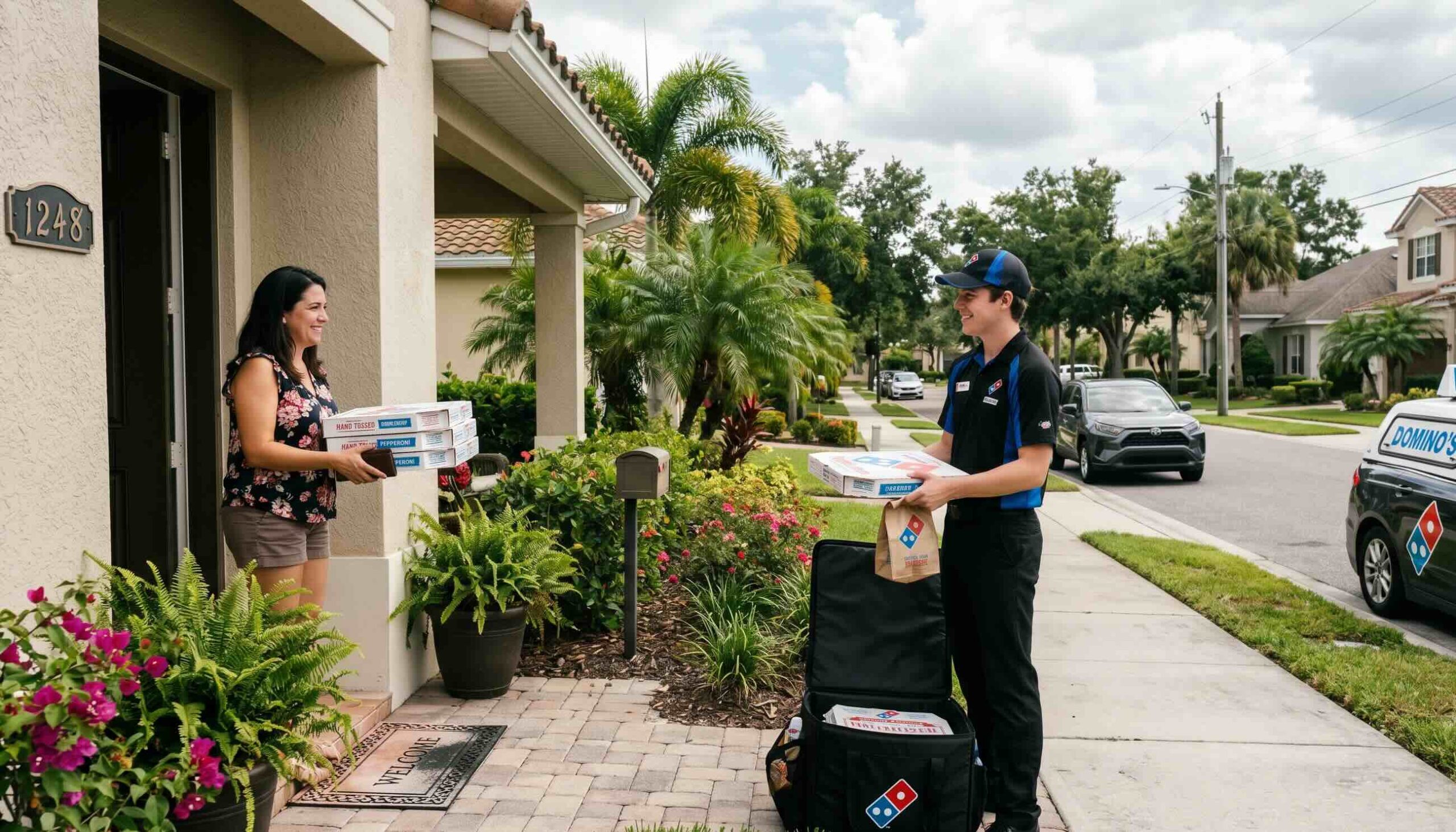
The AnyWare campaign was the public face of the tech pivot. The idea was simple: wherever a customer had a connected device, Domino’s would be there. You could order via an emoji. You could save your order as the “Easy Order” and reorder it with a single text. The friction between craving and checkout collapsed to near zero.
This was not just convenience. It was a data collection machine. Every digital touchpoint gave Domino’s insight into customer behavior, order patterns, and delivery performance that they could use to optimize the business. The competitors who were still taking orders primarily by phone had no equivalent data infrastructure.
By the Numbers
- Domino’s stock price: $3 in 2009, $500+ by 2021 (a 16,500% increase)
- Q1 2010 same-store sales growth: 14.3% (vs. industry average of 3-4%)
- Digital sales went from near zero to 75%+ of all US revenue by 2019
- AnyWare platform: orders accepted via 15+ different platforms and devices
- Domino’s overtook Pizza Hut as the #1 pizza company in the world by revenue in 2017
- The company operates in 90+ countries with over 19,000 locations globally
- Same-store sales grew for 40+ consecutive quarters after the 2010 relaunch
Why Radical Honesty Worked: The Business Logic
The instinct in corporate crisis management is to protect the brand. Legal teams advise against admissions of fault. PR agencies counsel careful language. The conventional playbook says: acknowledge concerns, emphasize positives, pivot to the future.
Domino’s violated every rule of that playbook and won. Here is why it worked:
1. The problem was already public knowledge. Every Domino’s customer knew the food was mediocre. Pretending otherwise would have been insulting. By acknowledging what everyone already knew, Domino’s converted a liability into a credibility signal. They are telling us what we already know, which means we can trust them when they say they fixed it.
2. The fix was real. If Domino’s had run the same campaign without actually changing the recipe, it would have been a disaster. The honesty campaign only worked because the pizza actually improved. Customers who tried it after the campaign could taste the difference. That tangible change is what converted curiosity into repeat purchase.
3. It created a story with stakes. Corporate turnarounds are inherently compelling narratives. They have a villain (the old product), a moment of reckoning (the campaign), and a resolution (the new recipe). Domino’s gave customers a reason to root for them, and people who root for a brand become evangelists.
We call this the Phoenix Framework (Hustler’s Library): when a brand’s public failure becomes the foundation of a stronger second act. The key variable is whether the follow-through matches the admission. Without that, you just have a very expensive confession.
Compare this to how Stewart Butterfield turned a failed video game into Slack: the pivot worked because it was built on honest assessment of what was actually working, not on defending the original vision. Domino’s and Butterfield both succeeded by stopping the pretense and following the data.
The Tech Play Is the Bigger Lesson
The recipe overhaul gets most of the attention in this story. The tech pivot is the more consequential one.
By reframing itself as a technology company, Domino’s changed the competitive set it was playing in. Pizza Hut and Papa John’s were still competing as restaurant chains. Domino’s was competing with the digital convenience of any e-commerce experience. It built for zero-friction ordering at a time when the entire economy was moving in that direction.
The lesson for entrepreneurs is not “build an app.” It is: identify the actual constraint between your customer’s desire and their purchase. For Domino’s, the constraint was not quality alone. It was also friction. The effort required to order, the uncertainty about when food would arrive, the lack of visibility into the process. They systematically removed every one of those constraints while the product got better simultaneously.
If you are building a business that takes orders in any form, your ordering experience is part of your product. A service that is good but difficult to access will always lose to a service that is great and effortless. If you need help structuring a business that can scale operationally, tools like LegalZoom can help you get the foundational legal structure in place so you can focus on building the thing that matters.
For context on how another brand used a complete identity overhaul to dominate its category from an underdog position, read our breakdown of how Liquid Death sold water for $700M. Different product, same insight: when everyone in your category plays it safe, being radically different is not a risk. It is the strategy.
What This Means for Your Business
Most founders have a version of the Domino’s problem somewhere in their business. A product that underperforms. A service that has a known flaw that no one internally wants to say out loud. A gap between what the brand promises and what the customer actually experiences.
The Domino’s case is not an argument for admitting every mistake publicly. It is an argument for radical honesty internally first, followed by radical action, and then, if the fix is real, telling that story with confidence.
The sequence matters: fix it, then tell people you fixed it. What Domino’s did not do was announce the campaign before the new recipe was ready. The product improvement came first. The marketing came second. That order is everything.
If you are running a business and want your own operations properly structured to handle growth, consider setting up with Northwest Registered Agent so the legal and administrative foundation can support what you build on top of it.
Key Takeaways
- Radical honesty only works when it is backed by radical action. The campaign was not the turnaround. The recipe overhaul was. The campaign just told people about it.
- Acknowledge what your customers already know. If the weakness is public knowledge, defending it destroys trust. Owning it and fixing it builds it.
- Fix it first, market it second. Domino’s had 18 months of recipe development before a single ad ran. Sequence matters.
- Reframe your competitive category. Calling itself a tech company let Domino’s compete on a dimension where Pizza Hut and Papa John’s were not even playing.
- Reduce friction at every touchpoint. AnyWare was not a gimmick. It was a systematic removal of every barrier between craving and checkout.
- A compelling turnaround story creates brand evangelists. People who watched Domino’s admit failure and then deliver on the fix became loyal customers precisely because they had witnessed the journey.
Sources & Further Reading
- Domino’s Pizza Inc.: Annual reports and investor presentations, 2009-2021
- QSR Magazine: “How Domino’s Became a Tech Company” (2016)
- Harvard Business School: Domino’s Pizza turnaround case study (2014)
- Adweek: “Domino’s ‘Pizza Turnaround’ Campaign” case study (2010)
- Forbes: “Why Domino’s Is the Most Innovative Company in Fast Food” (2018)
Want more breakdowns like this? Join Hustler’s Library free and get access to our full case study vault.
Ready to Know Where You Stand?
The Business Journey dashboard maps your exact position across all 13 stages. Track your progress, unlock resources for each step, and build with a framework used by thousands of founders at Hustler's Library.

No credit card required · Takes 3 minutes · Personalized to your stage