Water is water. It hydrates you. It has no personality, no story, no soul. It is the most commoditized product on earth. And yet, Mike Cessario looked at a can of water and saw a $700 million company hiding inside the branding.
That’s not a lucky accident. That’s a thesis executed with ruthless consistency. This is the Liquid Death case study: how a Netflix creative director turned a joke concept into one of the fastest-growing beverage brands in America by selling attitude to a market that was only selling hydration.
The Contrarian Thesis That Started Everything
Mike Cessario wasn’t a beverage industry veteran. He was a creative director who had worked at agencies and at Netflix, where he learned how to make people feel things through content. His insight wasn’t about water at all. It was about energy drinks.
Cessario noticed that energy drink brands like Monster and Red Bull had built massive, fiercely loyal audiences by aligning themselves with subcultures: action sports, gaming, heavy metal, extreme living. Their customers didn’t just drink the product. They wore the brand. They identified with it. The drink was almost beside the point.
Then he looked at water. Pristine mountains. Serene lakes. Soft blue packaging. Wellness influencers holding up sleek bottles with captions about “staying hydrated.” The entire category was competing on the same bland axis of purity and health. Nobody was owning a different emotional lane.
His bet: take the energy drink playbook, strip out the synthetic ingredients, and pour it into canned water. Give water an identity that made it cool to drink in the same rooms where Monster cans were being crushed. Target the exact demographic that the wellness water brands were quietly writing off: young men, skaters, metal fans, punk kids who would rather be caught dead than drinking something that looked like it belonged in a yoga studio.
The name “Liquid Death” wasn’t edgy for the sake of edgy. It was a precise positioning device. It signaled everything instantly: this is not your gym teacher’s water bottle.
Getting Into Whole Foods Before the Product Existed
Here’s the detail that separates Liquid Death from a thousand other “clever branding” startups that went nowhere. Before Cessario had a single pallet of product, he got a meeting with Whole Foods.
In 2018, he launched a Facebook page for Liquid Death with a single concept video. It was shot to look like a heavy metal horror film. It went viral with zero ad spend. The video racked up over three million views and became the proof of concept Cessario needed to walk into a buyer meeting and say: look, we don’t need to tell you there’s a market. The market is already showing up.
That’s a masterclass in de-risking a pitch. Most founders walk into retailer meetings with a deck full of projections. Cessario walked in with actual consumer demand already on record. Whole Foods agreed to carry the product in select stores. The brand had retail distribution before it had a scaled supply chain.
This is a move worth studying. If you’re building a consumer brand and trying to crack retail, the question isn’t “how do I make a great product?” The question is “how do I prove demand before I need to?” Social media is a free market research tool. A viral video is a letter of intent from your future customers.
If you’re at the stage of forming your business entity before pitching retail, using a service like Northwest Registered Agent to get your LLC or corporation set up properly gives you the credibility backbone before those early buyer meetings happen.
The Heavy Metal Aesthetic as a Competitive Moat
Once Liquid Death had distribution, the question became: how do you stay weird at scale? Most brands start edgy and gradually sand down the rough edges as they grow. They hire a big agency, run a focus group, and end up looking like everyone else within three years.
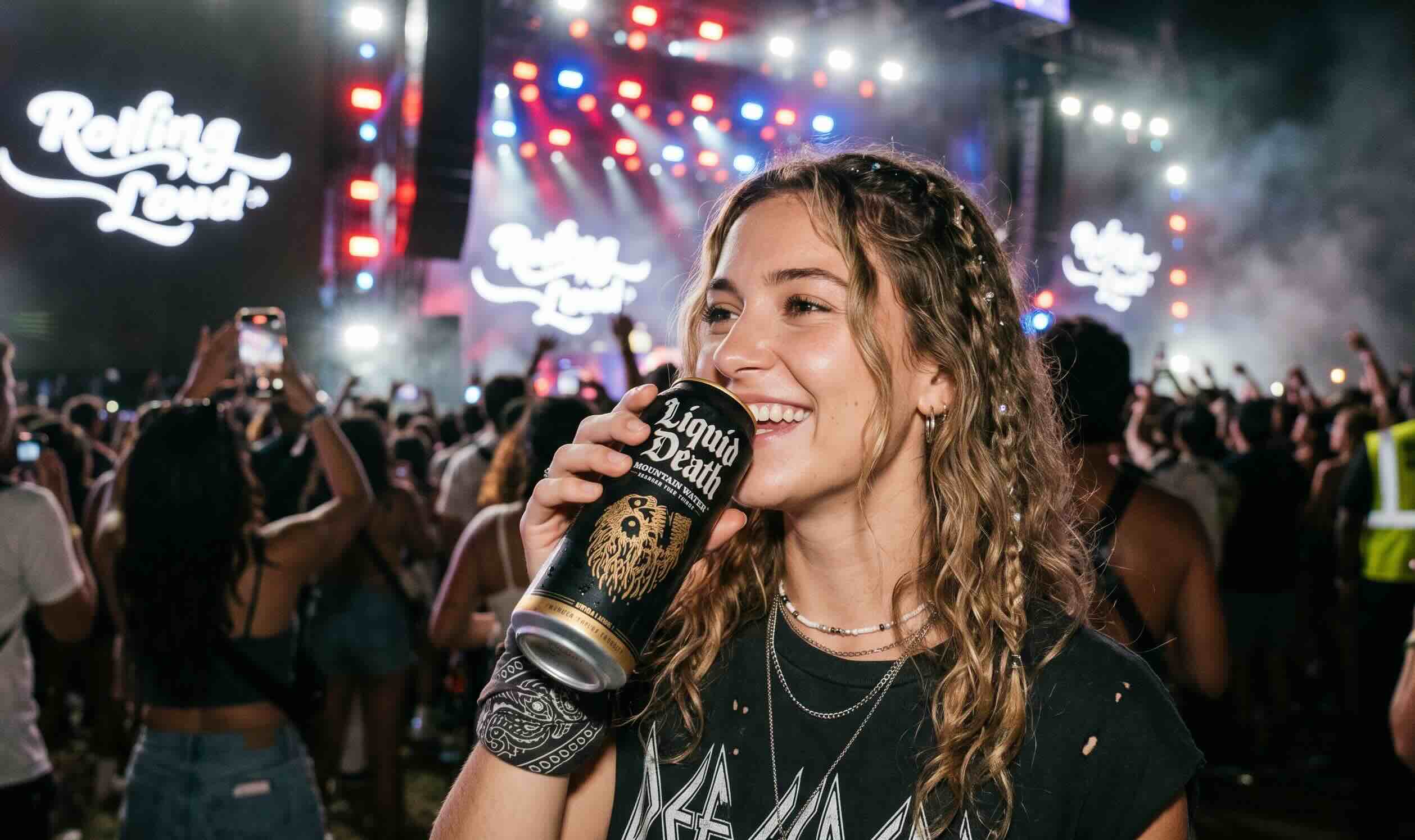
Cessario built the aesthetic into the company’s DNA at the structural level. The tall-boy can format was chosen deliberately because it mirrors what you’d see at a concert in someone’s hand: it reads as a beer at a distance. The skull logo, the gothic font, the black and silver palette. These aren’t design choices made by a committee. They’re load-bearing walls in the brand architecture.
Every piece of content the brand puts out is filtered through the same irreverent, absurdist, death-obsessed lens. They’ve sold merch that included a “Death to Plastic” skateboard and a “Greatest Hits” album featuring sounds of water being poured. They’ve run ads that looked like true crime documentaries. They hired Tony Hawk to do a stunt where he skateboarded in a pool of water mixed with his own blood to sign skateboards. That video hit tens of millions of views.
The moat isn’t the can. The moat is the fact that no serious competitor can copy the aesthetic without it looking like a desperate imitation. A Nestle or Coca-Cola sub-brand cannot release a death-themed water product without it becoming a joke. The brand equity Liquid Death has built is specifically designed to be uncopyable by legacy players.
For entrepreneurs thinking about positioning, this is the principle worth internalizing: the strongest brand moats are the ones built on identity, not features. Features can be copied overnight. Identity takes years to earn and is almost impossible to fake. You can read more about this kind of contrarian positioning thinking in our entrepreneur profiles section, where founders who broke their categories share how they did it.
Celebrity Investors and the Attention Economy Play
Liquid Death raised $75 million in a Series D round in 2022 at a $700 million valuation. Before that, the brand had pulled in strategic investors that included names designed to generate press: Wiz Khalifa, Shailene Woodley, and others in the entertainment and music world.
These weren’t just capital injections. They were earned media machines. Every time a celebrity investor was announced, it triggered another cycle of coverage: music blogs, entertainment outlets, business press. The brand was constantly in the news without running a traditional PR playbook. Cessario understood that in the attention economy, your investor list is a marketing asset.
Travis Barker of Blink-182, a figure with deep roots in exactly the punk and skate subculture Liquid Death was targeting, became a brand ambassador. His involvement wasn’t a paid endorsement that felt transactional. It was authentic because the overlap between his audience and Liquid Death’s target customer was nearly complete. When the right celebrity aligns with your brand’s worldview, it’s not just awareness. It’s credibility transfer.
By 2023, Liquid Death had grown to over $260 million in retail sales. It was outpacing category giants in its retail channels on a per-SKU basis. The product is still just water. Still just aluminum. Still the same molecules you get from a tap.
Viral Social Content as a Growth Engine
Most beverage brands treat social media as a broadcast channel. They post product shots, lifestyle imagery, and the occasional sponsored athlete clip. Liquid Death treats social as its primary R&D lab for culture.
Their content team operates more like a comedy writing room crossed with a punk zine. They respond to comments with absurdist wit. They lean into criticism. When people complain that they’re overcharging for water, the brand doubles down: yes, you’re buying attitude, not just water, and you know it.
The “Murder Your Thirst” tagline isn’t just a catchphrase. It’s a content permission structure. It tells the team: anything that could plausibly come from a brand called Liquid Death is on the table. That creative latitude is rare in consumer packaged goods, where legal and brand safety teams tend to defang anything interesting before it goes live.
Running that kind of content operation requires real infrastructure: a content calendar, collaboration tools, fast approval cycles. Teams at this scale typically run on tools like Google Workspace for shared docs, asset management, and coordinating across creative, marketing, and distribution functions without things falling through the cracks.
If you want to go deeper on content-led brand building, the principles Cessario applied map closely to what you’ll find in books like This Is Marketing by Seth Godin. Our book recommendations section has it listed alongside other titles worth reading if you’re building a brand from scratch.
What This Means for Commodity Market Founders
Liquid Death is a case study in one specific skill: finding the unloved emotional lane in a saturated category.
Every commodity market has a dominant aesthetic. Coffee has the artisan third-wave vibe. Water has the clean wellness vibe. Protein powder has the gym bro vibe. The question is always: who is being left out? Who would buy this product but refuses to identify with the dominant brand personality?
For water, the answer was: anyone who found wellness branding insufferable. That’s a massive segment. It includes people who don’t want to look like they’re trying. Skaters who need hydration but can’t be seen with a bottle that has a mountain on it. Music fans. People who find irony more appealing than sincerity in their packaged goods.
Cessario didn’t invent these people. He just built the only product that acknowledged they existed.
If you’re forming a company to go after an underserved segment like this, getting your legal foundation right early matters more than most founders realize. A service like LegalZoom can help you get through entity formation, trademarks, and the compliance side so you can stay focused on the brand work that actually builds the moat.
The other lesson is timing. Liquid Death launched in 2018 when the canned water trend was just beginning to build. The single-use plastic backlash was accelerating. The “better for you” beverage category was growing. Cessario didn’t create those tailwinds. He positioned his brand to catch them while everyone else was zigging toward minimalist wellness aesthetics.
Steal This
1. Prove demand before you need it
Liquid Death got Whole Foods distribution by showing up with millions of views on a concept video. Before you pitch a retailer, investor, or distributor, find a way to put real consumer signal in the room with you. A viral post, a waitlist, a sold-out pre-order: these are worth more than any projection spreadsheet.
2. Build your aesthetic as infrastructure, not decoration
The skull logo and gothic font aren’t cosmetic. They’re the moat. Design your brand identity to be so specific to your target customer that it becomes impossible for a larger competitor to replicate without looking fake. Vagueness is cheap to copy. Strong point of view is not.
3. Find the unloved emotional lane
In any commodity category, map out the dominant aesthetic and ask who it excludes. The people the category doesn’t serve are your best customers if you build something that finally sees them. This is a positioning move, not a product move: the product is water.
4. Treat your investor list as earned media
Strategic celebrity investors who align with your brand’s subculture generate coverage that paid PR can’t buy. Every Liquid Death investor announcement was also a content event. If you’re raising capital, think about who in your round generates headlines in the publications your customers actually read.
5. Give your content team creative latitude with a clear filter
Liquid Death’s content works because the brand voice is unambiguous: dark, irreverent, absurdist. That clarity gives the team permission to move fast without approval loops killing the spontaneity. Define your voice so precisely that your team can act on it without asking every time.
Ready to Know Where You Stand?
The Business Journey dashboard maps your exact position across all 13 stages. Track your progress, unlock resources for each step, and build with a framework used by thousands of founders at Hustler's Library.

No credit card required · Takes 3 minutes · Personalized to your stage