Five Guys opened its first location in Arlington, Virginia in 1986. Jerry Murrell, his wife Janie, and their sons ran it as a small family burger shop. They did not franchise for nearly two decades. They had four sons and later a fifth, which is where the name came from. For 18 years, they operated a handful of locations in the Washington D.C. area and focused entirely on making a better burger.
When they finally started franchising in 2003, demand was immediate. Within two years, they had sold franchise rights for over 300 locations. Today there are more than 1,700 Five Guys locations worldwide. The company is worth an estimated $1.5 billion. The Murrell family still owns it. The product philosophy from 1986 has not changed.
No Freezers. No Heat Lamps. No Shortcuts.
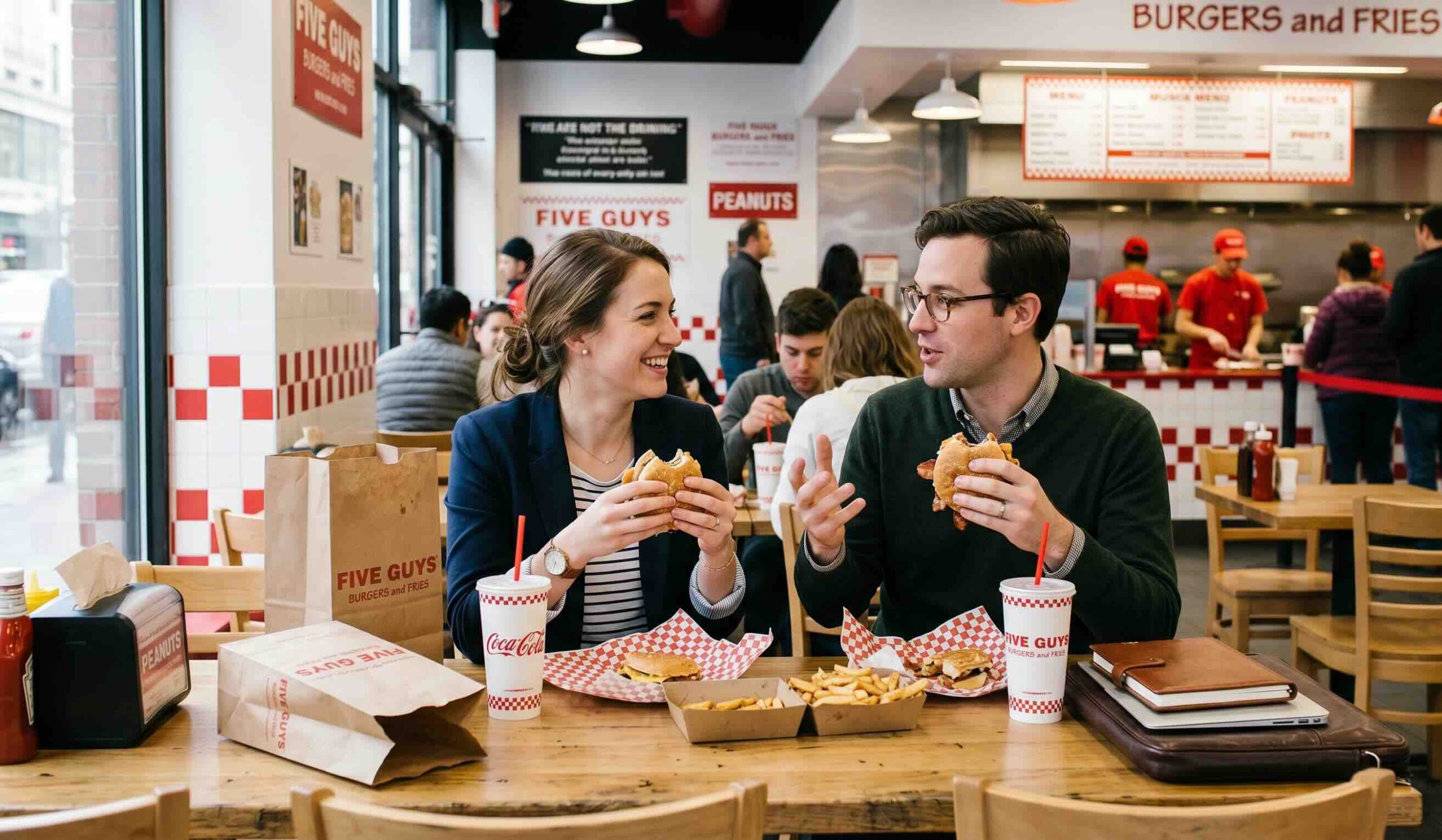
Walk into a Five Guys and look at the kitchen. There are no freezers. The beef arrives fresh and is never frozen. Potatoes are cut and cooked to order, never pre-cooked and held under heat lamps. Burgers are made when you order them, not before. Every bun is toasted. You can see the kitchen because it is open.
These are not small operational decisions. They are structural commitments that make certain shortcuts impossible. You cannot speed up service by pre-cooking burgers if there are no pre-cooked burgers. You cannot cut corners on ingredients if there are no frozen alternatives. The constraints are built into the physical setup of the restaurant.
This is operational commitment: the practice of building your quality standards into the physical and operational infrastructure so deeply that compromising them requires dismantling the system. The commitment is credible because it is visible. Customers who walk in see exactly what is happening. That visibility is part of the brand.
Costco uses a similar principle with its $1.50 hot dog. The price has not changed since 1985. It is a commitment so public and so embedded in the brand’s identity that raising it would be a cultural event. Five Guys’ fresh-never-frozen policy functions the same way: it is a public commitment that the brand is accountable to.
By the Numbers
- Founded: 1986, Arlington, Virginia
- Founders: Jerry Murrell, Janie Murrell, and their five sons
- Years before franchising: approximately 18 (first franchise locations: 2003)
- Franchise locations sold in first two years after opening: 300+
- Total locations worldwide: 1,700+ as of 2023
- Estimated company valuation: $1.5 billion
- Ownership: still private, Murrell family controlled
- Policy: no frozen beef, no freezers in any location
- Peanut oil for frying: a deliberate quality and flavor choice, posted prominently due to allergy concerns
- Free toppings: 15+ toppings included at no extra charge, a margin decision that builds perceived value
Mystery Shoppers and Public Score Posting
Five Guys uses mystery shoppers aggressively. Third-party evaluators visit locations unannounced, order food, and grade the experience across a detailed scorecard: food temperature, preparation accuracy, cleanliness, service speed, and customer interaction. The scores are posted publicly inside the restaurant. Every employee can see the most recent score. Every customer who walks in can see it.
This is an accountability mechanism that functions both internally and externally. Internally, it creates pressure to maintain standards because performance is visible to the team. Externally, it signals to customers that standards are being measured and that the brand takes them seriously enough to publish the results.
The practice also creates competition between locations. Franchise owners see their scores relative to others. High-performing locations have bragging rights. Low-scoring locations have an incentive to improve that extends beyond corporate enforcement. The mystery shopper system turns quality maintenance into something closer to a game with real stakes.
Accountability architecture is the design of systems that make performance visible to all stakeholders in ways that create intrinsic motivation to maintain standards. It is more sustainable than policing from above because the motivation to perform is distributed across the organization rather than concentrated in management.
Deliberate Expansion While Competitors Raced
While McDonald’s, Burger King, and Wendy’s were competing on speed of expansion and price, Five Guys was sitting still. For 18 years after opening, they operated a small cluster of D.C.-area locations and worked on the product. When they finally franchised, they did not do it cheaply. The Five Guys franchise fee is approximately $25,000, with total investment requirements ranging from $306,000 to $780,000. These are not the lowest numbers in the quick-service segment.
The pricing is deliberate. Cheap franchise fees attract franchisees who are primarily focused on minimizing upfront cost. Higher fees select for operators who are investing meaningfully and are therefore more committed to protecting their investment through quality execution. The franchise fee is part of the quality filter.
Jerry Murrell has said in interviews that he was not interested in expanding until he was confident the product could be replicated. That patience is unusual. Most founders feel pressure to scale before they have fully solved the operational problem. Five Guys solved it first. The result is a brand with remarkably consistent quality across over 1,700 locations, which is not a given in the franchise world.
This mirrors the discipline that defines Dutch Bros’ expansion approach: they grew by training employees into management rather than hiring externally, which slowed expansion but produced a more consistent culture at each location. Slow is smooth. Smooth is fast, eventually.
The Premium Price as a Filter
Five Guys costs more than McDonald’s. A double cheeseburger with fries at Five Guys is roughly $15-18 in most markets. The same category of meal at McDonald’s is under $10. Five Guys does not compete on price. It competes on quality, freshness, and portion size.
The premium price is not just a margin decision. It is a customer filter. Customers who are primarily optimizing for price will go to McDonald’s. Customers who are paying $16 for a burger expect the experience to match the cost. That expectation creates accountability on both sides: the brand must deliver, and the customer has already indicated they value quality over convenience.
This is price-as-positioning: using a premium price point to self-select a customer who has higher expectations and is therefore more likely to become a loyal advocate when those expectations are met. YETI uses the same logic with a $300 cooler: a customer who pays that price is already committed to the brand before they open the box.
The HL Quality Moat Framework
The HL Quality Moat Framework (Hustler’s Library framework) maps how Five Guys turned operational restraint into a sustainable competitive position:
- Non-negotiable standards are built into physical infrastructure (no freezers)
- Physical infrastructure makes quality visible and shortcuts structurally impossible
- Visible quality sets customer expectations at a premium level
- Premium expectations justify premium pricing
- Premium pricing filters for quality-oriented customers and franchisees
- Quality-oriented franchisees execute the standards consistently
- Mystery shopper system measures and publicly reports on execution
- Consistent execution builds reputation and repeat customers
- Strong reputation enables continued premium pricing and selective expansion
Each element reinforces the others. The moat is the system, not any individual decision.
If you are building a business with franchise potential or planning to bring on co-owners and partners as you scale, structuring your entity correctly from the start protects the quality standards you have worked to establish. Northwest Registered Agent and LegalZoom both offer business formation services that handle the legal foundation while you focus on the product.
Key Takeaways
- In a race to the bottom on quality, refusing to participate is the strategy. While competitors cut corners to expand faster, Five Guys built a position where quality is the entire point.
- Build your quality standards into physical infrastructure, not just policy. No freezers means no frozen beef. The commitment is structural, not aspirational.
- Accountability architecture sustains standards at scale. Mystery shoppers with publicly posted scores create distributed accountability across 1,700 locations.
- Slow expansion is a quality investment. Five Guys spent 18 years solving the operational problem before scaling. That patience produced a more consistent product than most of their competitors.
- Premium pricing is a filter, not just a margin strategy. A customer who pays $16 for a burger is telling you what they value. Design the experience accordingly.
- Family ownership protects long-term thinking. Without public shareholders or private equity timelines, the Murrells could make patient decisions that public competitors could not justify.
Sources & Further Reading
- Inc. Magazine, “The Five Guys Story” — profile of Jerry Murrell and the founding
- Forbes, “Five Guys: The Burger King That Isn’t” — private company profile
- QSR Magazine, Five Guys franchise model and unit economics
- Business Insider, mystery shopper program analysis and Five Guys operational standards
- Five Guys Franchise Disclosure Document (FDD), 2022 — franchise fee and investment ranges
Want more breakdowns like this? Join Hustler’s Library free and get access to our full case study vault.
Ready to Know Where You Stand?
The Business Journey dashboard maps your exact position across all 13 stages. Track your progress, unlock resources for each step, and build with a framework used by thousands of founders at Hustler's Library.

No credit card required · Takes 3 minutes · Personalized to your stage