There is no industry on earth with tighter margins, faster feedback loops, and less tolerance for error than the restaurant business. The average restaurant operates on margins between 3% and 9%. Labor is expensive and unpredictable. Inventory spoils. Customers are unforgiving. And yet, somehow, the best restaurants run like clockwork.
If you run a small business in any industry, that should get your attention. Because the operational discipline, customer obsession, and culture-building that keeps a great restaurant alive for decades contains lessons that translate directly into whatever you do. These are not metaphors. They are systems and habits that work, pressure-tested in one of the hardest environments in commerce.
Here is what the restaurant world has figured out that most small business owners have not.
Speed of Feedback Is a Competitive Advantage
In a restaurant, you know within 20 minutes whether a new dish is landing. Servers report back. Plates come back empty or half-eaten. The chef adjusts. There is no quarterly review cycle. There is no 60-day waiting period before you decide the new menu item was a mistake.
Most small business owners let bad decisions linger for months because they do not build fast feedback into their operations. The restaurant mindset flips this: design your business so that customers tell you what is working right now, not after the damage is done. Shorten the loop between offering something and finding out whether it resonates. Build in the equivalent of the server asking how the food is, every time, with every customer.
The Pre-Shift Meeting Is One of the Most Valuable Rituals in Business
Before every service, the best restaurants hold a pre-shift meeting. The team reviews the reservations. They hear about the specials. They talk through any issues from the night before. Every person who touches the guest experience knows what to expect before the first customer walks in.
This is not a big meeting. It is 10 to 15 minutes of shared context that prevents a hundred small failures during the shift. Most small business owners skip this entirely, especially as a solo operator or small team. The result is that every day starts from scratch, with no shared understanding of what today’s priorities are, what obstacles exist, or how the team should handle specific situations.
You do not need to run a restaurant to borrow this. A brief daily or weekly alignment conversation, even a few bullet points in a shared message, changes how your team executes. Context is a performance tool.
Mise en Place Is Not Just a Kitchen Concept
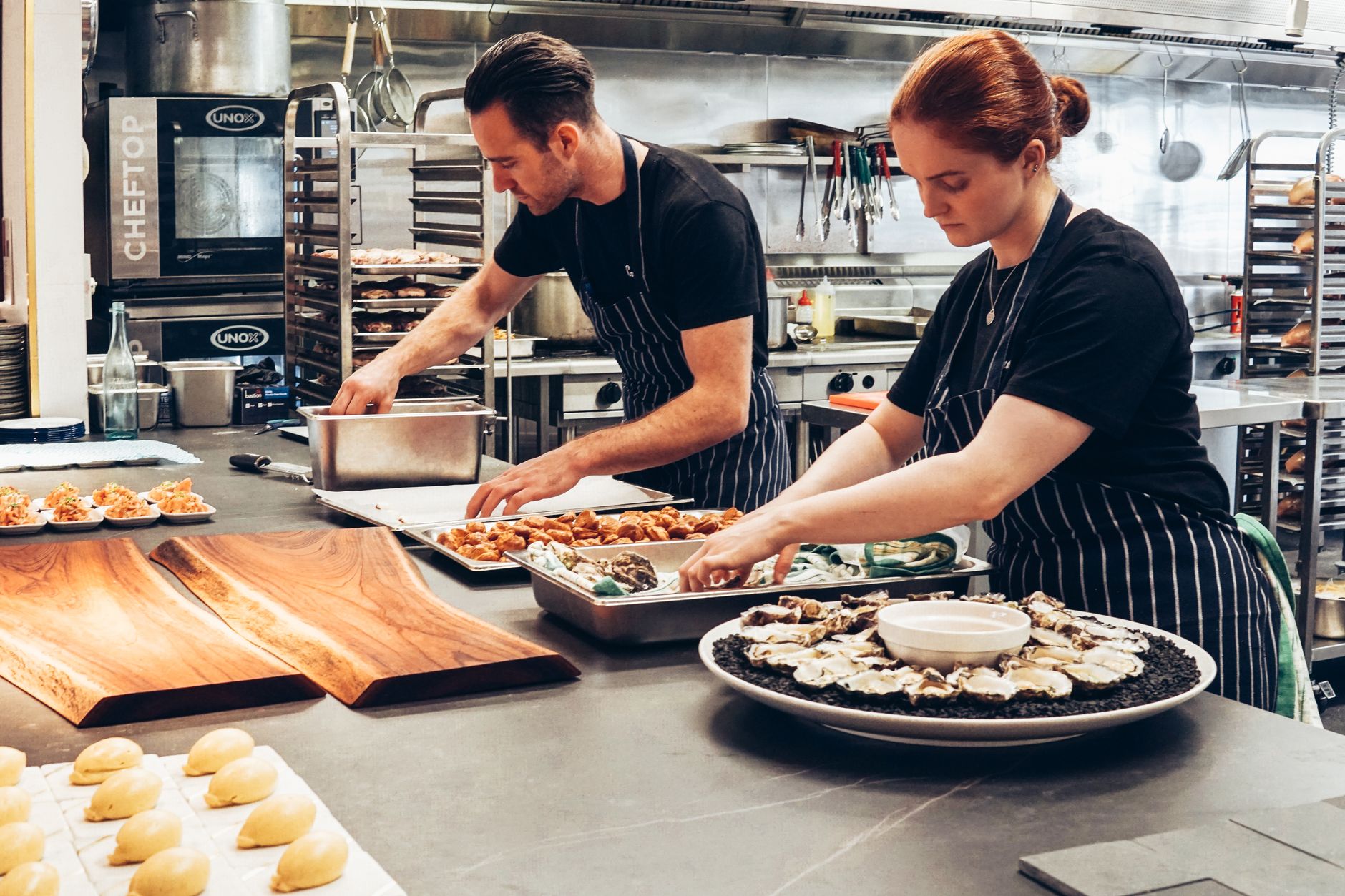
Mise en place is French for “everything in its place.” It is the practice of prepping, organizing, and positioning every ingredient and tool before service begins. A chef who does not practice mise en place becomes the chef who is always scrambling, always reacting, always behind.
The business translation is preparation before execution. The small business owner who sits down to their most important task without the context, tools, and information they need will spend the first 30 minutes of that task just getting oriented. Apply mise en place thinking to your workday: before a sales call, know the client’s context cold. Before a project kickoff, have every deliverable defined. Before a hiring decision, have your evaluation criteria written down. Preparation is a multiplier on execution quality.
The Best Restaurants Are Ruthlessly Consistent
What separates a restaurant with a loyal customer base from one that is always chasing new diners is consistency. A guest who comes back three months later and gets the same perfectly executed dish they had on their first visit becomes a regular. A guest who gets a different version every time becomes a person who stops coming back.
Consistency is not the enemy of creativity. It is the foundation that makes creativity possible. In your business, this means having clear standards for every repeatable interaction: how you respond to inquiries, how you onboard new clients, how you deliver your core product or service. Variation in quality erodes trust faster than almost anything else. The most profitable small businesses share this habit: they build systems that produce the same result regardless of who is executing them or what day it is.
Margins Are Managed at the Line, Not in the Office
A restaurant that is losing money on food cost is not fixed by a new budget spreadsheet. It is fixed by a line cook who understands the yield on every protein, the cost per portion, and what happens when they over-pour a sauce. Profit is protected at the point of production, not in a weekly report.
Most small business owners manage margins from the top down. The restaurant teaches you to manage them from the bottom up: every person on your team who touches your product or service should understand the cost implications of their work. When a service team member knows that a discounted deal affects their department’s numbers, they make different decisions. Financial awareness is not just a leadership skill. It is a cultural one.
The Experience Is the Product
Guests at a great restaurant are not just buying food. They are buying how it felt to be there. The greeting at the door, the pacing of the meal, the way the server remembered they were celebrating something, the moment the dessert arrived with a candle without being asked. The food has to be excellent, but the experience wraps the food in something that makes it memorable.
Your small business is the same way. Whatever you sell, the experience of buying it, using it, and being supported through it is part of the product. Clients and customers do not just evaluate your deliverable. They evaluate the entire journey. The responsiveness, the professionalism, the small gestures that show you were paying attention. This is where differentiation lives, especially when your core offering looks similar to competitors.
Waste Is the Enemy of Profit
A restaurant that wastes ingredients wastes money in a way that compounds every single day. The best operators track their waste religiously, repurpose ingredients creatively, and build purchasing systems that minimize spoilage. Every dollar that hits the trash is a dollar that never had the chance to become margin.
In a service or product business, waste looks different but the principle holds. Wasted hours on low-value tasks. Wasted marketing spend on channels that do not convert. Wasted capacity in a team that is underutilized. The discipline of tracking and eliminating waste is one of the harder lessons in business, but it is also one of the highest-leverage habits you can develop as an owner.
Culture Is Set by the Chef, Not the Menu
The great restaurant kitchens are known for their culture as much as their food. That culture is shaped at the top. A chef who is exacting but fair, who gives feedback in real time, who holds standards without humiliating the team, creates a kitchen where people want to perform at a high level. A chef who runs on fear or ignores standards creates a kitchen where people do the minimum and leave at the first opportunity.
Your behavior as the owner is the single most powerful cultural input your business has. There are unwritten rules in every business, and most of them come from watching what the owner actually does, not from the mission statement on the wall. If you want a culture of accountability, be accountable. If you want a culture of excellence, hold yourself to the standard first.
Handle the Complaint at the Table, Not After They Leave
A great restaurant does not wait for a bad Yelp review to find out that the steak was overcooked. It has systems in place to catch the problem while the guest is still in the building. The server who checks in genuinely. The manager who walks the floor. The comp or the adjustment offered before the guest has to ask. These are not apologies. They are recovery plays that turn a bad experience into a story about how well the restaurant handled it.
Most small businesses wait. They wait for the client to say something. They wait for the complaint email. They wait for the negative review. By then, the relationship is already damaged and the narrative is already written. Build your business like the best restaurants: actively look for problems before they become crises. Follow up during the engagement, not just after it ends.
The Bottom Line
Restaurants are laboratories for the fundamentals of small business. They operate at speed, on thin margins, with high customer expectations and complicated human dynamics. The ones that thrive do not succeed on talent alone. They succeed because they have built systems, standards, and cultures that perform consistently under pressure.
That is the lesson. Whatever industry you are in, you can steal the discipline that the best restaurants have developed over decades. Prepare before you execute. Close the feedback loop fast. Protect margins at the point of production. Make the experience the product. Handle problems before they escalate. Build a culture by example, not edict.
The restaurant world buries almost every business that opens in it. The ones that survive can teach the rest of us something important about how to run a company worth running.
Want more no-fluff business strategy built for small business owners? Join Hustler’s Library for free and get the kind of content that actually moves the needle.
Ready to Know Where You Stand?
The Business Journey dashboard maps your exact position across all 13 stages. Track your progress, unlock resources for each step, and build with a framework used by thousands of founders at Hustler's Library.

No credit card required · Takes 3 minutes · Personalized to your stage