In 1953, a guy named Troy Smith drove through a root beer stand in Louisiana and had a thought: what if people did not have to get out of their cars to eat? He went back to Shawnee, Oklahoma, rigged up a speaker system at his Top Hat drive-in, and watched the orders roll in faster than he could fill them. That was the beginning of Sonic.
Seventy years later, Sonic has over 3,500 locations across 46 states, generates more than $1 billion in system-wide sales, and sells more drinks per location than almost any other fast food chain in America. And here is the part most people miss: Sonic is not really a burger company. It is a beverage company that happens to serve burgers. Once you see it that way, the whole business model clicks.
The Origin Story: Keeping What Everyone Else Dropped
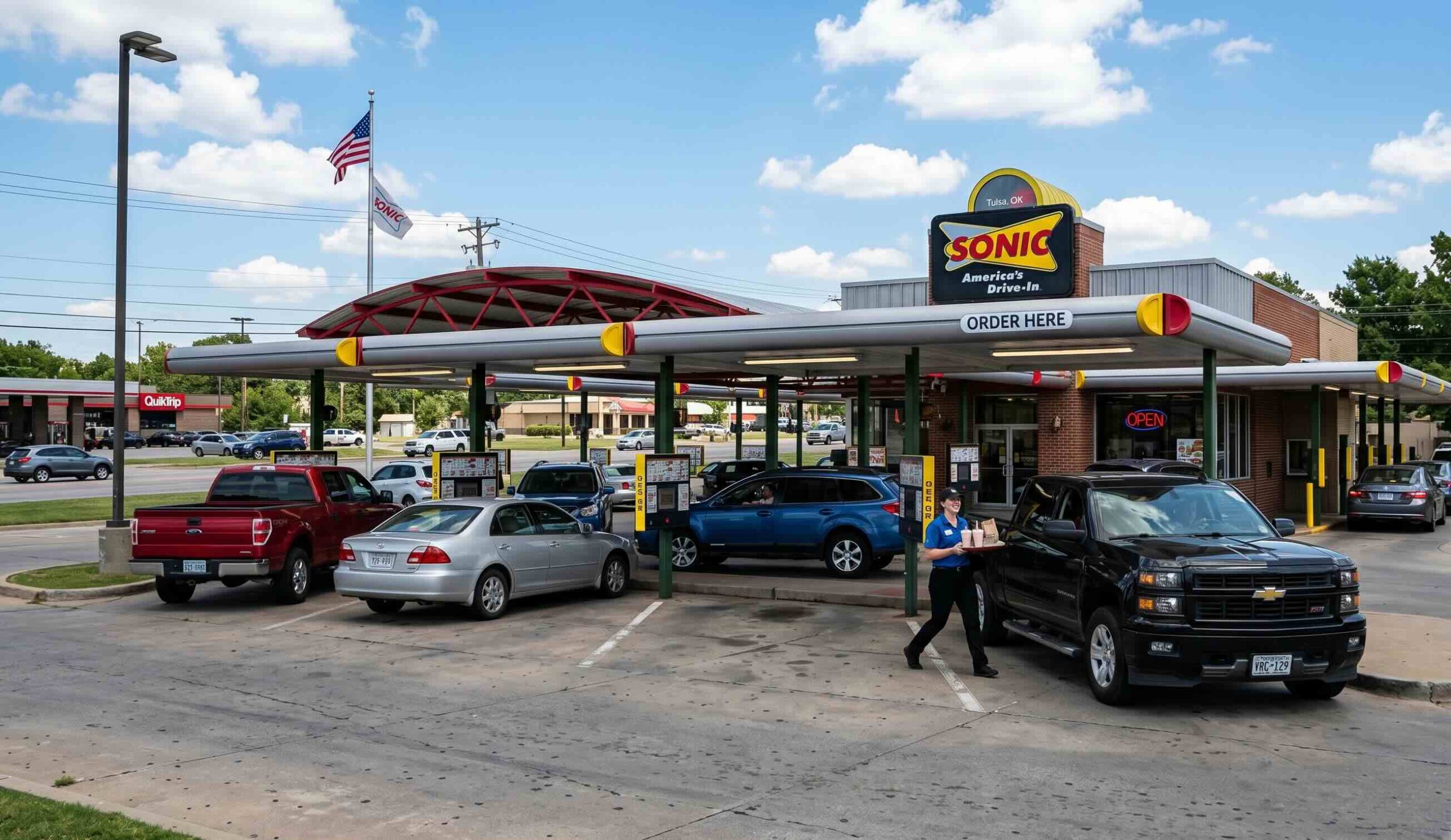
The drive-in was everywhere in the 1950s. Carhops, roller skates, window trays, and a parking lot full of cars. This was American fast food before McDonald’s showed the industry how to standardize everything and speed it up.
Then the industry shifted. McDonald’s, Burger King, and Wendy’s all moved toward indoor seating, drive-throughs, and assembly-line efficiency. The carhop model was slow, labor-intensive, and hard to scale. So the industry buried it.
Sonic kept it.
That decision looks obvious in hindsight, but it was not. Keeping the carhop model in an era of drive-through dominance was a contrarian bet. What Sonic understood is that abandoning a format everyone else ditches can make you the only one. There is no competitive pressure in a category of one.
This is what business strategists call differentiation through deliberate anachronism: holding onto something old-fashioned not out of nostalgia, but because it creates an experience no competitor can replicate without rebuilding their entire operation. Sonic’s competitors cannot just add carhops tomorrow. The real estate, the stall layout, the training, the culture: it is all baked in. That is a moat.
The Drink Machine: Why Sonic’s Real Business Is Beverages
Here is the number that should change how you think about Sonic: a Route 44 drink, 44 ounces of soda, slush, or limeade, costs Sonic somewhere between $0.20 and $0.30 to make. It sells for $1.50 to $3.00 or more depending on customization. That is an 80 to 90 percent gross margin on a single cup.
Burgers? Chicken sandwiches? Those margins are nowhere close. Food items carry real ingredient costs, labor for prep, and waste from spoilage. A drink is mostly ice, syrup, and water. The cost of goods barely moves even when you add flavor shots, real fruit, or candy mix-ins. Meanwhile, the customer perceives enormous value because the combinations feel custom and premium.
Sonic leans into this hard. Their drink menu offers thousands of combinations: slushes, limeades, flavored sodas, add-ins like coconut, vanilla, or nerds candy. The customization creates perceived value that justifies full pricing while the actual cost of goods barely budges. It is a masterclass in margin management disguised as a fun menu.
Compare this to McDonald’s, where beverages account for roughly 35 percent of revenue. At Sonic, drinks and snacks combined are estimated to represent over 50 percent of total sales. This is not a coincidence. This is the entire business model dressed up as a menu.
For franchisees, the math gets even better. Drinks require minimal labor: no grill time, no assembly, minimal prep. They have almost no waste. You make them to order and they are gone in five minutes. In a QSR operation where labor and food costs are the two biggest line items eating into your margins, high-volume beverages are a dream product. The more drinks Sonic sells, the more profitable each location becomes without adding complexity to the operation.
Happy Hour Is Not a Discount. It Is a Business Strategy.
Every weekday from 2 to 4 PM, Sonic sells drinks at half price. This is known as Happy Hour, and it has become one of the most recognizable promotions in fast food. People plan their afternoons around it. Parents make it a ritual with their kids. It is a cultural institution in the states where Sonic operates.
Here is what most people do not understand: Sonic is still making money on every single cup sold during Happy Hour.
When your margin on a product is 80 to 90 percent, cutting the price in half does not make it a loss leader. It makes it a slightly less profitable item that now drives enormous traffic to your slowest daypart. The 2 to 4 PM window is historically dead for fast food. People are not hungry enough for a full meal and they are not in a rush. Sonic turned that dead zone into one of their most trafficked hours of the day.
A customer who comes in for a half-price drink during Happy Hour often adds a snack. They tell their friends. They make it a Tuesday ritual. Over a lifetime, a Happy Hour customer who visits twice a week is worth thousands of dollars in revenue to a Sonic franchisee, and it all started with a $1.00 drink.
This is the loss leader principle applied at its most effective: use a discounted high-margin product to build a habitual customer whose lifetime value vastly exceeds what you gave up at the point of sale. The drink is cheap. The habit is priceless.
The Ritual Economy: When Your Product Becomes a Feeling
There is a business concept worth naming here: the ritual economy. A product enters the ritual economy when customers stop buying it because they need it and start buying it because it is part of their routine. The product becomes tied to a time, a place, a feeling, a memory.
Sonic has this in a way that Wendy’s or Burger King simply does not. Ask someone who grew up in Oklahoma, Texas, or the South about Sonic and you will hear about Friday nights in the parking lot, Happy Hour with their mom, first dates in a car with the window down. These are not just transactions. They are anchored to identity.
This is what we at Hustler’s Library call the HL Ritual Brand Framework: a brand earns ritual status when it captures a specific time, place, or emotion that no competitor occupies. Once you are in someone’s routine, you are not competing on price or product quality anymore. You are competing against habit itself, and habit almost always wins.
Starbucks has morning. Dutch Bros has the drive-through energy boost. Dutch Bros built their entire culture around creating that hit of joy at the window, a feeling people return to every single day. Sonic has the afternoon snack stop, the summer evening hang, the parking-lot social moment. These are not overlapping. Sonic is not competing with Starbucks for morning coffee. They carved out a completely different slice of the day.
The snack stop positioning matters because it opens dayparts that other QSRs miss entirely. Most fast food chains are built around three meals. Sonic built a fourth moment: the between-meal pause, the 3 PM pick-me-up, the “let’s go to Sonic” impulse that does not fit into breakfast, lunch, or dinner. That incremental visit is pure upside.
By the Numbers
- 3,500+ Sonic locations across 46 states
- Over $1 billion in annual system-wide sales
- Founded: 1953, Shawnee, Oklahoma by Troy Smith
- Route 44 drink cost of goods: approximately $0.20 to $0.30 per cup
- Route 44 retail price: $1.50 to $3.00+ — delivering an 80 to 90 percent gross margin
- Drinks and snacks: estimated at over 50 percent of Sonic’s total sales mix
- McDonald’s beverage share: approximately 35 percent of revenue (by comparison)
- Acquired by Inspire Brands in 2018 for approximately $2.3 billion
- Inspire Brands portfolio includes Arby’s, Buffalo Wild Wings, Dunkin’, Baskin-Robbins, and Jimmy John’s
- Thousands of drink combinations available on the customization menu
- Happy Hour (2 to 4 PM) historically the slowest QSR daypart, turned by Sonic into a traffic and margin engine
The Franchise Model: Own the Brand, Not the Building
Sonic’s business structure is a lesson in leverage. The company owns the brand, the system, and the royalty stream. Franchisees own the real estate, the equipment, and the day-to-day operational headaches. This separation is intentional and powerful.
When Inspire Brands acquired Sonic in 2018 for roughly $2.3 billion, they were not buying 3,500 restaurants. They were buying a royalty engine: a brand that collects fees on every dollar of revenue generated across a massive network, without bearing the full burden of building and operating each location.
This is the same principle that makes QuikTrip’s vertical integration so valuable: own the thing that generates income without owning every physical asset that supports it. The franchisor’s risk profile looks completely different from the franchisee’s. Inspire collects royalties whether a location has a great quarter or a rough one. The franchisee absorbs the variance.
For entrepreneurs thinking about franchising their own concept, getting your legal structure right from the start is critical. Services like Northwest Registered Agent can help you establish the right entity structure before you scale, and LegalZoom is worth looking at for franchise disclosure documents and operating agreements. Get the paperwork right before you sell your first franchise, not after.
How a Regional Cult Brand Goes National Without Losing Its Soul
Sonic spent decades as a Southern and Midwestern institution before expanding nationally. That regional concentration was not a weakness. It was a proving ground. By the time Sonic entered new markets, it carried the cultural weight of something that already had cult status somewhere. People who grew up with Sonic moved to new cities and missed it. That nostalgia created built-in demand before a single location opened.
The lesson is sequencing. You do not need to be everywhere immediately. Dominate a region, build genuine loyalty, let the culture spread through word of mouth and migration, then follow your customers into new markets. Trader Joe’s used a nearly identical playbook: deep regional loyalty first, national expansion second, never losing the feeling that made people love it in the first place.
Sonic kept the carhop. They kept the stalls. They kept Happy Hour. They kept the made-to-order customization even when it slowed things down. Every decision to preserve the original experience was a decision to protect what made the brand worth anything in the first place.
For a growing franchise operation, using Google Workspace to keep a distributed team aligned becomes essential during expansion. The brands that scale without losing soul are the ones that build systems for consistency before they scale, not during the chaos of rapid growth.
Key Takeaways
- Differentiation through deliberate anachronism works. Keeping what everyone else dropped made Sonic the only one in its category. There is no competition in a category of one.
- Beverages are the real business. Drinks with 80 to 90 percent gross margins, minimal labor, and near-zero waste are the engine behind Sonic’s profitability. The burgers get the attention; the Route 44 pays the bills.
- Happy Hour is a habit machine, not a discount. Cutting the price on an 80-plus-percent margin product still makes money while building a ritual customer worth far more over their lifetime than the margin given up at the point of sale.
- The ritual economy is the most defensible market position. When your product becomes part of someone’s routine and identity, you are no longer competing on features or price. You are competing against habit, and habit wins.
- Own the brand; distribute the risk. Sonic’s franchise model separates brand ownership from real estate risk. Inspire Brands collects royalties on billions in system sales without owning most of the physical locations that generate them.
- Scale regionally before going national. Deep cult loyalty in a core market creates the demand pull that makes national expansion sustainable. Do not water down what makes you special by moving too fast.
Sources and Further Reading
- Inspire Brands acquisition press release and SEC filings (2018)
- QSR Magazine: Sonic franchise performance and beverage mix analysis
- Nation’s Restaurant News: Sonic drive-in history and model overview
- Technomic QSR consumer sentiment and beverage occasion data
- Franchise Times: Sonic franchisee economics and unit-level profitability
Want more breakdowns like this? Join Hustler’s Library free and get access to our full case study vault.
Ready to Know Where You Stand?
The Business Journey dashboard maps your exact position across all 13 stages. Track your progress, unlock resources for each step, and build with a framework used by thousands of founders at Hustler's Library.

No credit card required · Takes 3 minutes · Personalized to your stage