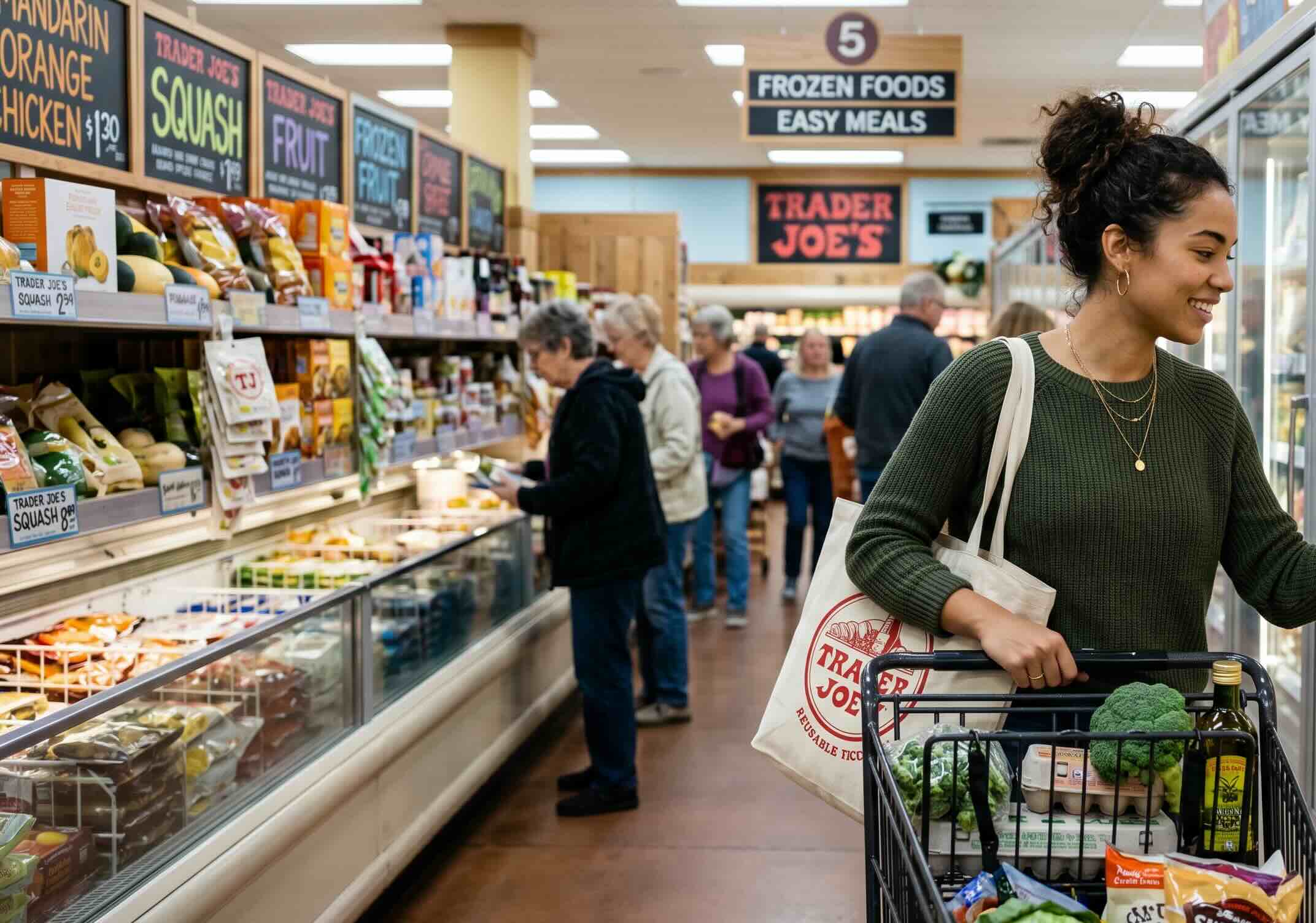
Walk into any Trader Joe’s on a weekday afternoon and you will find something unusual for a grocery store: the parking lot is full, the lines are long, and the customers do not seem to mind. They are engaged with the shelves, picking up items they have never seen before, reading the copy on the back of packages written in a voice that sounds nothing like a corporation. Some of them are talking to the staff, who are wearing Hawaiian shirts and actually seem to enjoy working there.
Trader Joe’s has no loyalty card. No weekly ad. No coupons. No self-checkout. No delivery service for most of its history. By every conventional metric of modern grocery retail, Trader Joe’s is doing it wrong. And yet the chain consistently ranks as one of the highest-revenue-per-square-foot grocery retailers in the United States, generating an estimated $2,000 or more per square foot annually: multiple times the industry average.
The Before: A Convenience Store With a Personality Problem
Trader Joe’s began as a small chain of convenience stores called Pronto Markets in Los Angeles in the 1950s. Joe Coulombe, the founder, recognized early that the model was unsustainable against the growing supermarket chains. He could not win on size, assortment, or price in a direct battle with conventional grocery.
So he changed the game entirely. In 1967, he rebranded as Trader Joe’s and began building something that had no real model in grocery retail: a store where the experience itself was the draw, and where the product selection was curated so carefully that customers trusted the store’s judgment the way they might trust a knowledgeable friend.
The Edge: Experience and Exclusivity Without the Exclusive Price
Trader Joe’s competitive advantage is a combination of factors that reinforce each other so seamlessly that copying any single one of them in isolation does not work. The four pillars are: private label obsession, product curation and rotation, staff culture, and a total rejection of conventional retail tactics.
The result is a store that feels like a discovery every time, a place where the products are good enough to justify loyalty but surprising enough to justify curiosity. Customers do not just shop at Trader Joe’s. They become advocates. They recommend specific items with the enthusiasm of someone sharing a personal find. The store has turned grocery shopping into something people actually like doing.
How They Executed It: The Mechanics of Cult Retail
1. Private Label Done Right Creates Category Ownership
Over 80% of Trader Joe’s products are private label. Like Aldi (which has long-standing ties to Trader Joe’s through the Albrecht family), Trader Joe’s buys directly from producers and sells under its own brand. But Trader Joe’s approach to private label is distinct: the products are not generic alternatives to national brands. They are curated, often genuinely novel items that you cannot find anywhere else. Cookie Butter. Everything But the Bagel seasoning. Mandarin Orange Chicken. These became cultural phenomena because they were exclusive to Trader Joe’s and genuinely good.
The exclusivity means that if a customer wants the product, they have to come to Trader Joe’s. There is no competitive shopping. No price comparison. The destination is the only option.
2. Product Rotation Creates FOMO That Drives Repeat Traffic
Trader Joe’s rotates its product selection seasonally and regularly introduces new items while quietly discontinuing others. This creates a dynamic that no loyalty program can replicate: customers visit frequently because they do not know what they will find, and they know that something they love might not be there next time. The anxiety of missing out is a more powerful driver of behavior than points.
The fear of discontinuation is so well understood by Trader Joe’s customers that petitions regularly appear online when a beloved product is cut. This level of emotional engagement with a grocery product is extraordinary. It is also free marketing.
3. The Staff Culture Is a Differentiator, Not Just a Nice-To-Have
Trader Joe’s employees are famously engaged. They are encouraged to sample products, share opinions, and actually help customers rather than just direct them to an aisle. Compensation is above industry average. Full-time crew members receive benefits that are uncommon in retail. The investment in staff quality shows up directly in the customer experience.
Trader Joe’s has ranked among the top grocery chains for employee satisfaction in multiple surveys. Happy employees create happy customers. This is not a philosophical point; it is an operational one. Staff turnover costs money. Staff engagement creates value. The math is clear.
4. The No-Frills Store Design Focuses Attention on Product
Trader Joe’s stores are small, typically under 15,000 square feet. There is no elaborate signage system, no self-checkout kiosk farm, no deli counter staffed by eighteen people. The simplicity keeps operating costs low and keeps the customer’s attention on the product rather than the infrastructure. Handwritten signs and chalkboards reinforce the approachable, neighborhood-store feeling. Every design choice communicates: this is a place run by real people who care about what they sell.
5. They Rejected Loyalty Programs Intentionally
The absence of a loyalty card is not an oversight. It is a position. Trader Joe’s believes that the product and experience should be what brings customers back, not points. Loyalty programs create a transactional relationship. Trader Joe’s wants an emotional one. The data they might collect from a loyalty program is less valuable to them than the clean simplicity of just being so good that people come back anyway. Before you analyze the competitive tactics your market uses, it is worth asking which of those tactics you should deliberately avoid.
Understanding what your customers value most requires the disciplined approach of real market research, not assumptions about what worked for your competitors.
Lessons Entrepreneurs Can Steal Today
Lesson 1: Exclusivity Does Not Require High Prices
Trader Joe’s products are affordable. The exclusivity comes from the fact that you can only get them at Trader Joe’s. If you can create products or services that are genuinely available only through you, you create a destination that competitors cannot undercut on price.
Lesson 2: Novelty and Rotation Drive Repeat Engagement
Customers who visit frequently and who never know exactly what they will find are engaged customers. Consider whether your business has a mechanism for introducing novelty on a regular basis: limited editions, seasonal products, rotating inventory. The fear of missing out is more powerful than almost any promotional tactic.
Lesson 3: Staff Is Part of the Product
In any business with a customer-facing component, the quality of your staff is experienced by every customer, every day. Underinvest here and everything else suffers. Overinvest here and it shows in ways that cannot be faked.
Lesson 4: Loyalty Programs Are Not the Only Way to Build Loyalty
Trader Joe’s proves that genuine product quality, a distinctive experience, and emotional connection are more powerful loyalty drivers than points and discounts. Points programs create price sensitivity. Great experiences create advocates.
Lesson 5: Rejecting Industry Conventions Can Be Your Brand
Every retail convention that Trader Joe’s has rejected, from weekly ads to loyalty cards to self-checkout, has become part of its identity. The refusal to do what everyone else does is itself a brand position. In your market, the conventions your competitors accept might be your best opportunity to differentiate.
The Takeaway
Trader Joe’s built one of the most loyal customer bases in retail not by tracking purchases, not by rewarding transactions, and not by outspending competitors on advertising. It built loyalty by being genuinely, consistently worth coming back to. The product is good. The experience is unique. The staff actually cares. And the store is always surprising enough to be interesting.
In a world of loyalty programs, data surveillance, and algorithmic personalization, Trader Joe’s remains proof that the simplest customer retention strategy is also the most durable one: just be so good that people don’t want to go anywhere else.
Want more strategic frameworks like this? Join the Hustlers Library for free and access the case studies, playbooks, and tools serious entrepreneurs use to build businesses that last.
Ready to Know Where You Stand?
The Business Journey dashboard maps your exact position across all 13 stages. Track your progress, unlock resources for each step, and build with a framework used by thousands of founders at Hustler's Library.

No credit card required · Takes 3 minutes · Personalized to your stage