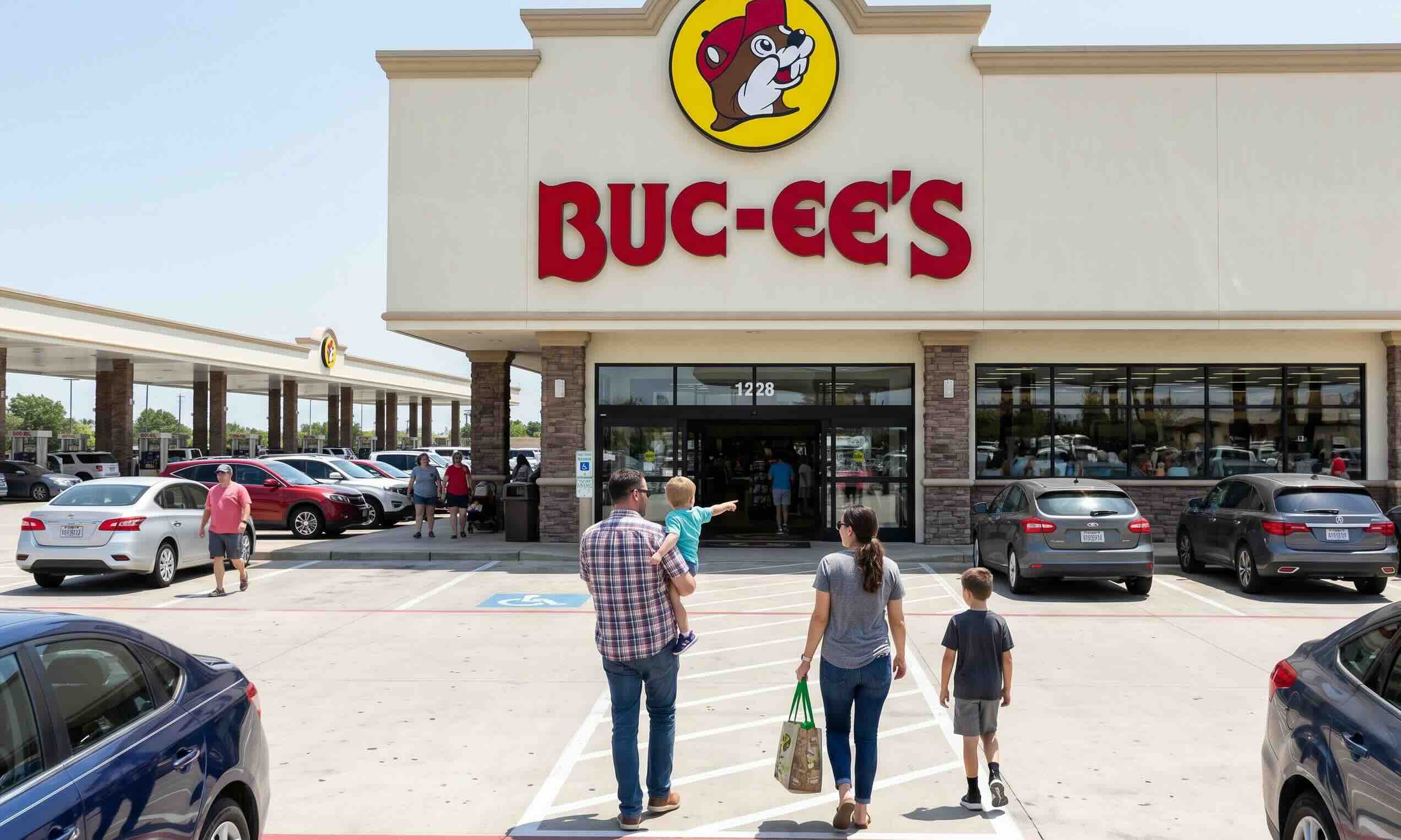
There is a Buc-ee’s location in New Braunfels, Texas that holds the Guinness World Record for the largest convenience store on earth: 66,335 square feet. For reference, that’s larger than a typical Walmart Supercenter. It has 120 fuel pumps. It has a 13-foot animatronic beaver named Buc-ee. And on most days, the parking lot is full.
People drive to it on purpose. They plan road trips around it. They post photos there like it’s a landmark. There are Buc-ee’s branded hats, shirts, and stuffed animals for sale inside, and they sell out regularly. The brisket sandwiches are genuinely excellent. The bathrooms are famously, almost comically clean.
None of this should work. Convenience stores are a commodity category. People stop because they need gas or a bathroom, not because they want to. Buc-ee’s broke that assumption so thoroughly that it has become a case study in how to redefine a category entirely.
The Origin: Going Bigger on Purpose
Buc-ee’s was founded in 1982 by Arch “Beaver” Aplin III in Lake Jackson, Texas. The early stores were conventional by industry standards. The transformation came when Aplin made a deliberate decision to go larger: significantly, dramatically larger than any competitor was willing to go.
The logic was counterintuitive but sound. Bigger stores require more investment, but they also allow for more product categories, which drives higher average transaction value and longer dwell time. They create a fundamentally different customer experience: you don’t feel like you’re making a pit stop, you feel like you arrived somewhere. And they create a story. Nobody talks about stopping at a normal gas station. They talk about Buc-ee’s.
The company expanded slowly and deliberately, choosing locations along major Texas highways where the customer capture radius could justify the scale. When they expanded to other states beginning in 2019, they applied the same site selection discipline: high-traffic corridors, strong real estate, and a format large enough to serve as an anchor destination rather than a waypoint.
The Real Estate and Location Strategy
Buc-ee’s doesn’t open in cities or suburbs. They open on interstates and highways, typically 30 to 90 minutes from major metro areas: exactly where road-trippers start looking for a reason to stop. The placement is calculated to catch customers who have already committed to a long drive and are actively seeking a break.
The stores are also intentionally built near smaller communities rather than competing directly with urban retail. This means lower land costs, faster permitting, and significant local economic impact that generates goodwill with municipalities. When Buc-ee’s opens in a smaller Texas town, it often becomes the largest employer and biggest taxpayer in the area. That kind of community footprint creates political and social capital that a suburban strip mall location never would.
The 120-pump fuel canopy is itself a strategic asset. At most gas stations, waiting for a pump is a friction point. At Buc-ee’s, the sheer number of pumps means you almost never wait. That removes the most common hesitation for stopping and lets the store itself do the conversion work.
The Product: A Category of One
What do you actually buy at Buc-ee’s? The question reveals the breadth of the model. On any given visit, a customer might purchase:
- Beaver Nuggets (caramel corn that has developed a genuine cult following)
- Freshly sliced brisket by the pound from a real smoker on premises
- Buc-ee’s branded beef jerky in over 20 flavors
- Fudge, kolaches, breakfast tacos, and fountain drinks in sizes that test physics
- Outdoor gear, camp supplies, and branded merchandise
- Seasonal and Texas-themed gifts
This isn’t a convenience store assortment. It’s closer to a specialty food hall with a gift shop attached. The food quality is genuinely good by any standard, not just by gas station standards. That distinction matters because it shifts the comparison set. You’re not comparing Buc-ee’s to a 7-Eleven. You’re comparing it to a local specialty food market, and it competes well on that basis.
The Cult Following: Why People Drive Out of Their Way
Buc-ee’s has developed the kind of brand loyalty typically associated with consumer goods or apparel brands, not fuel retailers. The company has no loyalty program. It does minimal traditional advertising. Growth has been driven almost entirely by word of mouth and social media.
The psychological mechanism is straightforward: Buc-ee’s gives people a story to tell. In a world where most service experiences are forgettable, an experience that’s genuinely surprising creates social currency. When you tell someone you stopped at a 66,000-square-foot gas station with 120 pumps and the best brisket you’ve had outside a dedicated BBQ restaurant, you have their attention. That story spreads. Buc-ee’s markets itself by being remarkable in the original sense: worth remarking on.
The bathrooms deserve special mention. Buc-ee’s has won awards for restroom cleanliness and staffs dedicated bathroom attendants during peak hours. In a category where bathroom quality is typically a liability, Buc-ee’s turned it into a brand asset. There are memes about the bathrooms. Road-trippers specifically plan stops around them. It sounds absurd until you realize that differentiation doesn’t have to be glamorous; it just has to be real.
By the Numbers
- Buc-ee’s flagship New Braunfels, TX store: 66,335 sq ft, the world’s largest convenience store (Guinness record)
- Largest Buc-ee’s fuel station: 120 pumps
- Over 50 locations across 13+ states as of 2024, with aggressive expansion underway
- Buc-ee’s is privately held; estimated annual revenue exceeds $1 billion
- The company started expanding outside Texas in 2019 (first out-of-state location: Alabama)
- Employee pay is reportedly among the highest in the convenience sector: full-time hourly wages starting around $15-$17, with reported compensation packages well above industry average
- New Buc-ee’s openings regularly draw opening-day lines; some customers travel 100+ miles specifically to visit
Key Takeaways
- Category redefinition: Buc-ee’s didn’t compete in the convenience store category; it created a new one. “Road trip destination” has different economics, different loyalty dynamics, and different growth potential than “gas station.”
- Scale as differentiation: Going dramatically larger than anyone else isn’t just a real estate decision; it’s a brand decision. Size becomes the story.
- Location strategy as a moat: Choosing the right geography (highway corridors, smaller communities, high-traffic capture zones) creates structural advantages that are hard to replicate in dense urban markets.
- Remarkable beats advertised: Buc-ee’s spends very little on traditional marketing because the experience generates its own word of mouth. Building something worth talking about is often cheaper than advertising something mediocre.
- Raise the floor on the basics: Clean bathrooms and good food aren’t revolutionary ideas. But executing them far better than the industry standard in a category where the bar is low creates outsized differentiation.
The Business Lesson: Become the Destination
Most businesses compete by trying to be better at the existing game. Buc-ee’s changed the game. They asked a different question: what if a gas station wasn’t a place you stopped at because you had to, but a place you stopped at because you wanted to?
That question unlocked a completely different business model: larger footprints, premium food, branded merchandise, destination marketing, and a customer experience engineered to generate stories rather than transactions. When you become the destination, you don’t need to compete on price or location or hours. People come to you.
If you’re building a business with ambitions to create a physical retail presence, entity formation and real estate strategy are foundational decisions. Northwest Registered Agent can help you get your legal structure right from the start, and LegalZoom is a solid resource for the contracts and agreements that come with scaling a physical footprint.
For more on how operational discipline and employee investment create sustainable differentiation, our Costco case study covers similar territory from a membership model angle. And for a brand that turned a product category into a lifestyle identity, see our breakdown of Lululemon’s $50B empire.
Sources & Further Reading
- Guinness World Records: Largest Convenience Store (Buc-ee’s New Braunfels, TX)
- “How Buc-ee’s Became the Cult Gas Station of the South,” The Atlantic, 2022
- NACS (National Association of Convenience Stores) industry data and reports (nacsoline.com)
- “Buc-ee’s Is Coming to a Highway Near You,” Wall Street Journal, 2021
- Berger, Jonah. Contagious: Why Things Catch On (2013) — the mechanics of word-of-mouth growth
Want more breakdowns like this? Join Hustler’s Library free and get access to our full case study vault.
Ready to Know Where You Stand?
The Business Journey dashboard maps your exact position across all 13 stages. Track your progress, unlock resources for each step, and build with a framework used by thousands of founders at Hustler's Library.

No credit card required · Takes 3 minutes · Personalized to your stage