In-N-Out Burger has fewer than 400 locations. McDonald’s has over 40,000. By every conventional metric of fast food success, In-N-Out should be irrelevant. Instead, it is one of the most recognizable, most talked-about, and most fiercely loyal quick-service brands in America. That gap between scale and status is the lesson.
The Snyder Family’s Deliberate Restraint
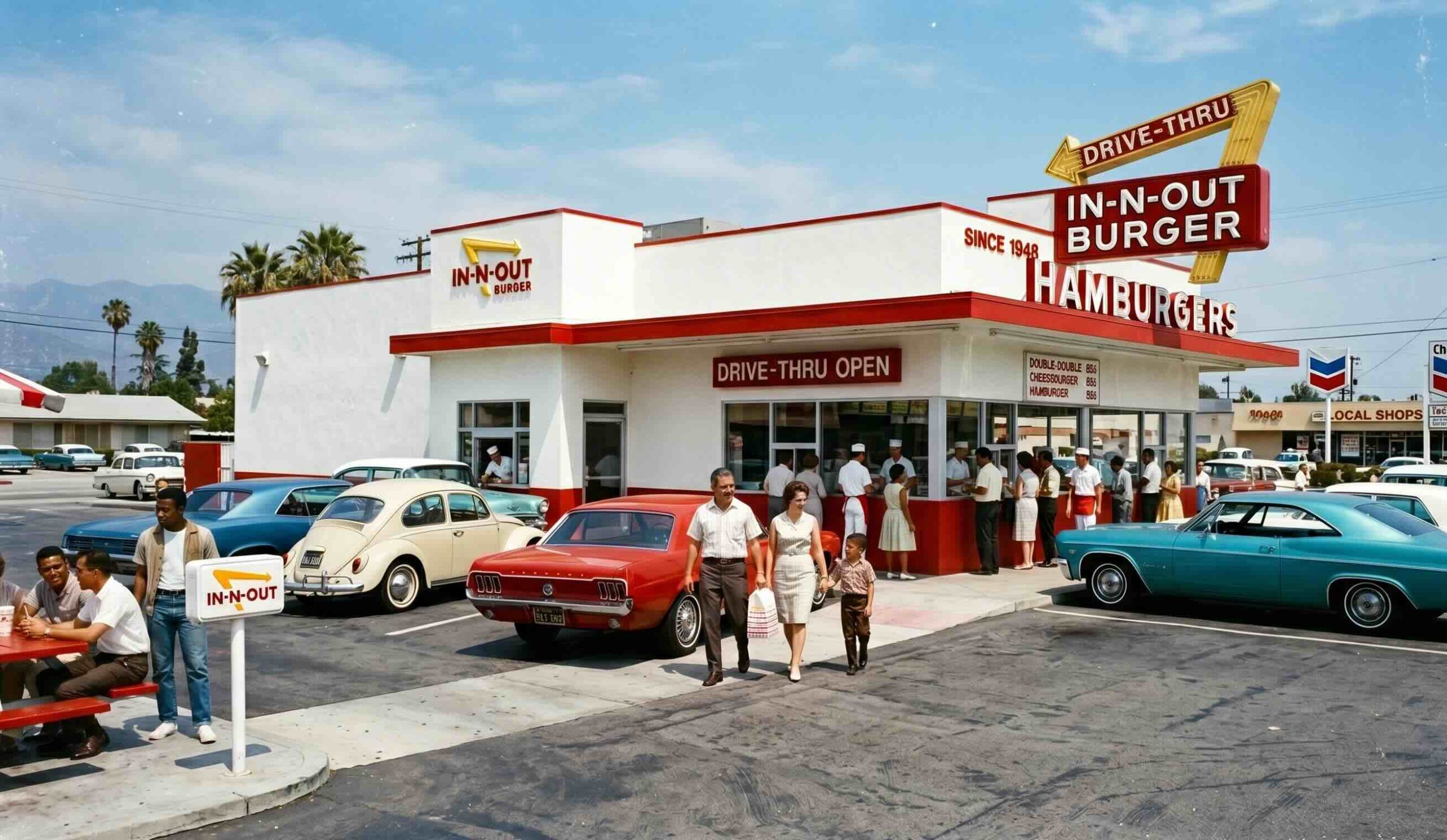
Harry Snyder and his wife Esther opened the first In-N-Out in Baldwin Park, California in 1948. It was California’s first drive-through burger stand. When Harry died in 1976, the company passed through family hands. When founder’s son Rich Snyder died in a plane crash in 1993, his brother Guy took over. When Guy died in 1999, the company passed to Lynsi Snyder, then 17 years old, who became sole owner at 30.
Through every transition, the family held one position: the company stays private, expansion stays controlled, and quality stays non-negotiable. That is not an accident. It is a strategy, even if it was never written in a deck.
Lynsi has turned down acquisition offers. The company has never pursued an IPO. There are no plans to enter every state, let alone go global. When a business decision comes down to “grow faster or stay true,” In-N-Out consistently chooses the latter. This is a form of constraint-based brand building: the deliberate use of limitations to create perceived value.
Constraint-based brand building is the practice of using scarcity, geographic limits, or product restrictions to strengthen brand desirability rather than chase maximum distribution. YETI used the same principle to build a $1.7B brand on a $300 cooler. Less availability, higher desire.
By the Numbers
- Founded: 1948, Baldwin Park, California
- Current locations: approximately 400, concentrated in the western United States
- Estimated brand value: over $1 billion (Forbes, private company estimate)
- Employee starting wage: consistently among the highest in fast food, often $20+ per hour in California markets
- Annual revenue estimate: approximately $900 million to $1 billion
- Never franchised: 100% company-owned locations
- States with locations: California, Nevada, Arizona, Utah, Texas, Oregon, Colorado, Idaho
- The “Secret Menu” has been referenced in mainstream media for over 30 years
Paying People Well Is a Business Strategy
In-N-Out is famous in the food service industry for paying above-market wages. In states where minimum wage is $16, In-N-Out often starts at $20 or more. Store managers reportedly earn six-figure salaries. That is not charity. It is systems design.
High employee pay in a low-margin industry produces measurable outcomes: lower turnover, higher consistency, faster service, and better customer experience. When a company like In-N-Out can deploy the same well-trained, experienced crew across every shift, it shows in the product. The fries are always fresh-cut. The burgers are always made to order. The lines move quickly despite high volume.
The fast food industry average annual turnover rate is roughly 150%. In-N-Out’s is a fraction of that. When competitors cycle through staff every few months, they are constantly retraining, constantly delivering inconsistent product, constantly losing institutional knowledge. In-N-Out pays to keep that knowledge in-house.
This is what operational moat looks like in practice. An operational moat is a competitive advantage built through superior internal execution rather than external factors like patents or exclusive contracts. The moat is invisible to competitors until the results are undeniable.
The Secret Menu: Word-of-Mouth You Cannot Buy
In-N-Out never advertised the “secret menu.” There was no press release. There was no influencer campaign. There was no viral moment engineered by a marketing team. The secret menu grew because employees told customers, customers told friends, and the experience of being “in the know” became a social currency.
The most famous items: Animal Style (mustard-grilled patty, extra spread, caramelized onions, pickles), Protein Style (lettuce wrap instead of bun), Double Double Animal Style, the 4×4, and the Flying Dutchman (two patties, two slices of cheese, nothing else). None of these appear on the menu board. All of them are consistently available at every location.
What In-N-Out built, without spending a dollar on it, is a participation economy around their product. A participation economy is a system where customer engagement is rewarded with insider access, exclusivity, or identity signals that motivate further sharing. Customers who know the secret menu feel part of something. They tell people who do not know. Knowing becomes a badge. This is organic word-of-mouth at its most sophisticated: the brand creates the conditions, customers do the work.
Compare this to the massive paid campaigns competitors run to launch limited-time items. In-N-Out’s secret menu has generated more cultural conversation than any of them, for decades, at zero media cost.
Geographic Scarcity as Brand Equity
Ask someone who grew up in the western United States about their first In-N-Out experience. You will get a story. Ask someone from the East Coast who has only heard about it. You will get longing. That longing is worth money.
When In-N-Out opened in Texas in 2011, people waited in line for hours. When locations open in Colorado or Utah, the same thing happens. Every new market entry is a cultural event, not a routine expansion. Competitors open in new cities with zero fanfare. In-N-Out opens with news coverage.
This is scarcity marketing: the brand is the scarcity. Scarcity marketing means limiting availability intentionally so that access to the product carries social value beyond the product itself. You cannot get it everywhere, so where you can get it, it matters. This mirrors what Dutch Bros built in the Pacific Northwest before expanding: an intensely regional identity that made expansion feel like an event rather than just another store opening.
The company also controls its supply chain with unusual tightness for a company its size. In-N-Out operates its own distribution centers and sources beef from a proprietary facility. This is why it has not expanded to the East Coast: it will not ship beef long distances or compromise its freshness standards. That constraint is a feature, not a bug. It is the reason every burger tastes the same in every location.
The HL Constraint Flywheel
The HL Constraint Flywheel (Hustler’s Library framework) describes how In-N-Out’s self-imposed limits reinforce each other in a compounding cycle:
- Controlled expansion keeps locations scarce and staff well-trained
- Well-trained staff produces consistent product quality
- Consistent product quality earns loyal customers who become evangelists
- Evangelists drive word-of-mouth (including the secret menu) at zero cost
- Word-of-mouth makes each new market entry a cultural event
- Cultural events reinforce scarcity perception and brand desire
- Brand desire allows the company to stay private, reject bad deals, and keep control
Each element feeds the next. Saying no to cheap franchising is what makes room for everything else to work.
If you are building a business and thinking about entity structure to protect long-term family ownership, tools like Northwest Registered Agent or LegalZoom can help you set up the right structure from day one, before there is anything to protect.
Key Takeaways
- Saying no to scale can be your most powerful growth strategy. In-N-Out has fewer than 400 locations and more brand equity than chains with 10 times as many.
- Employee compensation is a systems investment, not a cost. Paying above market reduces turnover, builds consistency, and creates operational advantages competitors cannot easily replicate.
- Scarcity creates desire. Geographic limits turned every In-N-Out opening into a news event. You cannot manufacture that with an ad budget.
- Organic word-of-mouth requires infrastructure, not just luck. The secret menu is not an accident. It is a knowledge system that rewards participation.
- Staying private protects mission. Without shareholder pressure, In-N-Out can make long-term decisions that public companies cannot justify to quarterly earnings calls.
- Constraints compound. Each limit In-N-Out imposes on itself reinforces the others. The whole is more valuable than any single decision.
Sources & Further Reading
- Stacy Perman, In-N-Out Burger: A Behind-the-Counter Look at the Fast-Food Chain That Breaks All the Rules (HarperCollins, 2009)
- Forbes, “America’s Largest Private Companies” — annual private company valuations
- QSR Magazine, various coverage of In-N-Out operations and expansion
- Los Angeles Times, coverage of In-N-Out expansion and ownership history
- National Restaurant Association, fast food industry turnover statistics
Want more breakdowns like this? Join Hustler’s Library free and get access to our full case study vault.
Ready to Know Where You Stand?
The Business Journey dashboard maps your exact position across all 13 stages. Track your progress, unlock resources for each step, and build with a framework used by thousands of founders at Hustler's Library.

No credit card required · Takes 3 minutes · Personalized to your stage