Buying a car from a traditional dealership is one of the most reliably terrible consumer experiences in existence. You go in with a price in mind. You spend three hours in a room being pressured by someone whose compensation depends on extracting maximum margin from you. You sign seventeen forms. You leave exhausted, uncertain whether you got a fair deal, and vaguely resentful. For more, see How LegalZoom Makes Money.
Carvana looked at that experience and saw an opportunity. Not just to make it better, but to rebuild it from the ground up. The result was a company that went from zero to a market cap over $30 billion in less than a decade, then nearly imploded, then came back. The full arc teaches something important about what happens when you fix an experience so broken that almost anything is an improvement.
The Car Vending Machine: Marketing Genius Disguised as Logistics
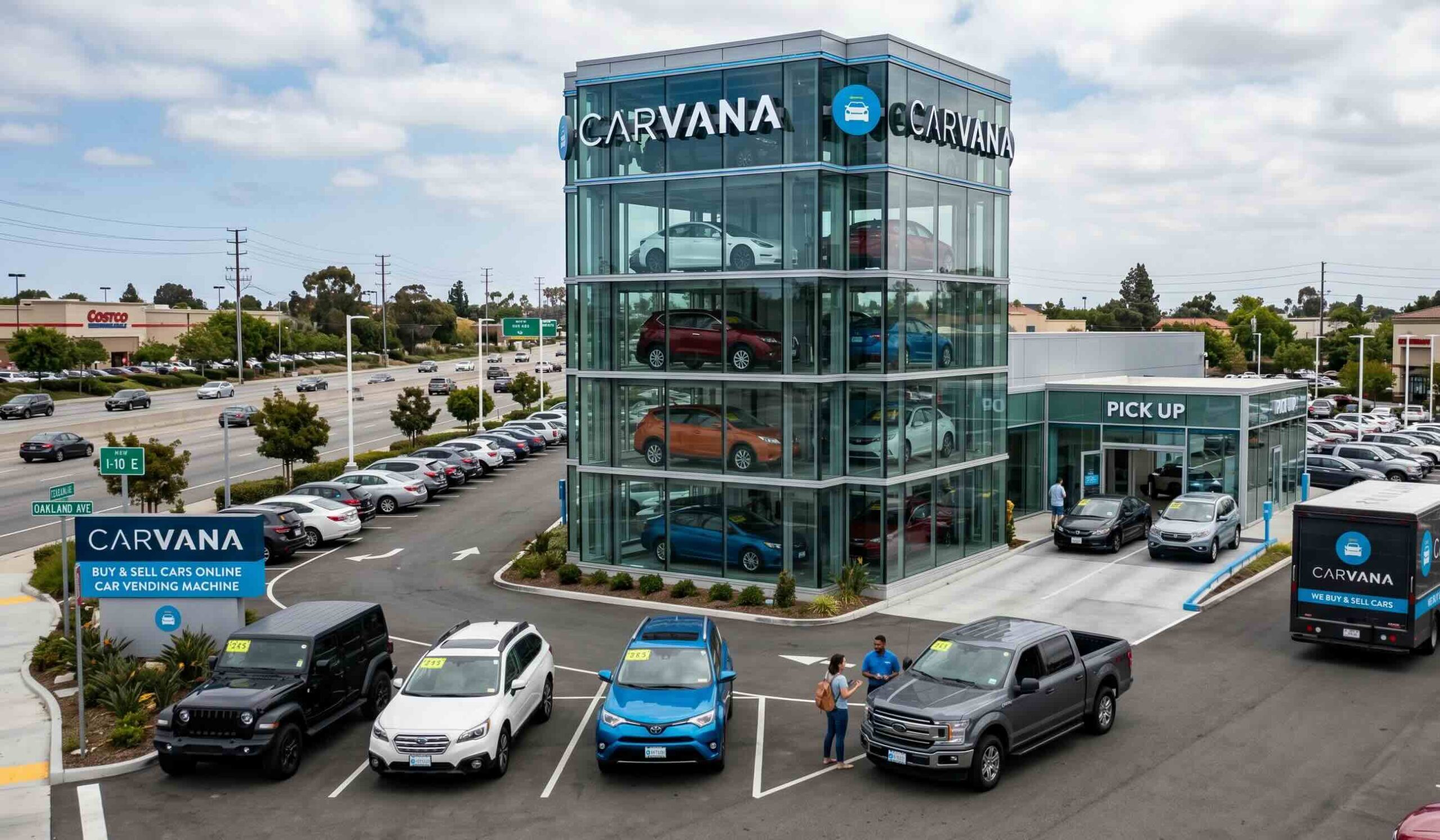
Carvana’s multi-story car vending machine towers are the most recognizable physical symbol of the brand. Glass towers, sometimes ten stories high, filled with colorful vehicles that customers can collect using a giant coin provided at purchase. They exist in dozens of cities across the US.
From a pure logistics standpoint, vending machine towers are expensive and operationally complex. Carvana does not need them to deliver cars. They have a perfectly functional home delivery model that works fine without a tower.
So why build them? Because they are impossible to ignore, impossible to mistake for a competitor, and they communicate the entire brand promise in a single image: buying a car here is different. It is automated, transparent, even fun. Every tower that gets built generates local media coverage. It is earned media embedded in infrastructure. For more, see Case Study.
This is marketing architecture at its best: a physical asset that does operational work and brand work simultaneously.
The UX Thesis: Eliminating the Worst Part
Carvana’s core insight is that the used car buying experience was not just inconvenient. It was actively hostile. Customers did not trust dealers. They did not know if prices were fair. They hated negotiation. They hated the time commitment. They hated the financing process.
Carvana eliminated all of it. You browse online. You see a 360-degree photo of every car. You see the vehicle history. The price is the price: no negotiation, no hidden fees, no back-room manager. You apply for financing online. You schedule delivery or tower pickup. You get a seven-day return window, no questions asked.
User Experience (UX) as a competitive weapon means designing every interaction with your product or service to be measurably better than the alternative, to the point where switching back to the old way feels unacceptable. In industries where the status quo experience is genuinely bad, a dramatically better UX is not just a feature. It is a business model.
The seven-day return policy deserves special attention. It removed the largest psychological barrier in the used car market: the fear of making an irreversible mistake. When you can return a car like a pair of shoes, the purchase decision becomes less stressful. Less stress means faster conversion. Faster conversion means lower customer acquisition cost.
By the Numbers
- Founded: 2012 by Ernie Garcia III, son of DriveTime founder Ernie Garcia II
- IPO: April 2017 at approximately $15 per share
- Peak market cap: over $30 billion (2021)
- Units sold 2021: approximately 425,000 vehicles
- 2022 losses: approximately $1.6 billion net loss
- Near-bankruptcy: 2022-2023, debt load exceeded $9 billion, stock fell over 98% from peak
- 2023 comeback: returned to profitability on an adjusted basis, stock recovered over 1,000% from lows
- Vending machine towers: over 30 locations across the US
The 2022 Collapse: What Went Wrong
Carvana nearly destroyed itself through a combination of pandemic-era overexpansion and a catastrophically timed debt binge.
During 2020 and 2021, used car prices surged because of supply chain disruptions. Carvana’s revenue exploded. Management interpreted a macro tailwind as proof that their growth model was sustainable at any scale, and they expanded aggressively: more markets, more inventory, more infrastructure, more headcount, all funded by debt.
When the used car market normalized in 2022 and interest rates rose sharply, Carvana was left holding massive inventory at inflated prices, paying high interest on a debt stack that exceeded $9 billion, and burning cash at a rate that alarmed even supportive investors.
The stock fell from a high of over $370 to under $4. Analysts debated whether the company would survive. Carvana responded with mass layoffs, a debt restructuring, and a ruthless operational refocus on unit economics over growth.
The 2023 Comeback: How They Survived
Carvana’s recovery was driven by three things: debt restructuring that reduced near-term payment pressure, operational discipline that dramatically cut costs per unit, and a used car market that began to stabilize.
By mid-2023, Carvana reported its first adjusted EBITDA profit since going public. The stock surged. Investors who bought near the lows made extraordinary returns. The company that was being written off as a cautionary tale had returned to relevance.
The core UX advantage never went away. Customers still preferred buying a car on Carvana to going to a dealership. The brand was intact. The near-death experience was a capital structure problem, not a product problem. That distinction matters enormously when assessing whether a struggling business is recoverable.
This recovery arc mirrors what we see in other companies that have near-death experiences: the ones that survive are those where the core value proposition remains intact even when the financials collapse. Compare this to how Spanx maintained brand integrity through financial discipline from the very beginning, never letting growth outpace the fundamentals.
Trust as the Product in a Trust-Deficit Industry
The automotive retail industry consistently ranks among the least trusted in consumer surveys. Dealerships have spent decades earning that reputation through adversarial sales tactics, opaque pricing, and financing practices that many consumers find predatory.
Carvana’s entire brand is built on being the opposite of that. Fixed pricing, transparent vehicle history, no-pressure browsing, easy returns. In a trust-deficit industry, being trustworthy is a differentiated product attribute, not just a nice-to-have.
Trust arbitrage is the competitive advantage gained when a new entrant behaves with more transparency and reliability than the incumbents in an industry with historically poor customer trust. The bar is low enough that basic decency becomes a moat.
If you are building a business in any industry with poor customer trust scores, read that again. You do not need to be perfect. You just need to be measurably better than the incumbents. In many industries, the gap between status quo and acceptable is enormous.
Getting your business structure right matters when you are building trust-first. Operating as a properly registered entity signals legitimacy to partners and customers. Northwest Registered Agent helps you get incorporated quickly and correctly, so your credibility starts from day one.
Key Takeaways
- In any industry where the status quo experience is terrible, a better UX is a business model. Carvana did not invent anything new. It just removed everything people hated about buying a car.
- Physical marketing assets can do double duty. The vending machine towers are both infrastructure and branding. When you can make an operational asset generate earned media, you have found a multiplier.
- Return policies remove psychological barriers, not just financial ones. The seven-day return window did not cost Carvana as much as it earned them in conversion rate improvement.
- Capital structure problems are not brand problems. Carvana nearly died because it borrowed too much during a boom. The core product was fine. That distinction is the key to reading turnaround potential.
- Trust arbitrage is real. In industries with historically poor customer trust, being transparently fair is a competitive advantage, not just an ethical choice.
Sources & Further Reading
- Carvana Annual Reports and SEC filings, 2018-2023
- Wall Street Journal: Carvana debt restructuring coverage, 2022-2023
- Bloomberg: “How Carvana Became the Most Dramatic Stock Story of 2023” (2023)
- Forbes: “The Rise, Fall, and Return of Carvana” (2023)
- CNBC: Carvana CEO Ernie Garcia III interviews, 2021-2023
Want more breakdowns like this? Join Hustler’s Library free and get access to our full case study vault.
Ready to Know Where You Stand?
The Business Journey dashboard maps your exact position across all 13 stages. Track your progress, unlock resources for each step, and build with a framework used by thousands of founders at Hustler's Library.

No credit card required · Takes 3 minutes · Personalized to your stage