Pricing is one of the most important decisions you will make as a small business owner. Set your prices too low and you work yourself into the ground for thin margins. Set them too high and you lose customers before they ever get to know your value. Getting it right takes a system, not a guess.
This guide breaks down the core pricing strategies used by successful small businesses, how to calculate a price that actually covers your costs, and how to raise prices without losing customers.
Start With Your Costs: The Floor You Cannot Go Below
Before you can price anything, you need to know what it costs you to deliver it. There are two types of costs to account for:
- Direct (variable) costs: Materials, labor, packaging, shipping, merchant fees. These scale with every unit you sell.
- Indirect (fixed) costs: Rent, insurance, software subscriptions, your own salary, utilities. These exist whether you sell one unit or a thousand.
Your break-even price per unit is: (Total Fixed Costs / Units Sold) + Variable Cost Per Unit. Anything below this number and you are losing money. Anything above it contributes to profit.
Most new business owners undercount their costs. They forget to include their own time, transaction fees, packaging, and the occasional returned order. Build a full cost sheet before you set a single price.
The Three Core Pricing Strategies
1. Cost-Plus Pricing
This is the simplest approach: calculate your total cost and add a markup percentage. If a product costs you $20 to make and you want a 50% margin, you sell it for $40.
Cost-plus pricing is easy to manage and ensures you always cover your costs. The downside is it ignores what customers are actually willing to pay, and it can leave money on the table in markets where buyers have high perceived value for your product.
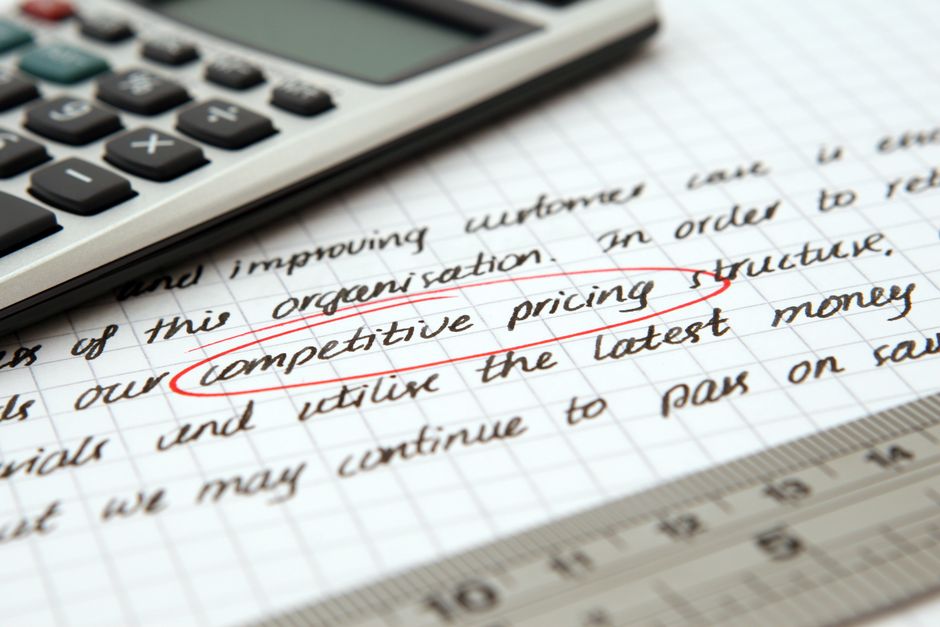
2. Competitive Pricing
You look at what your competitors charge and position yourself relative to them: at parity, slightly below, or slightly above. This approach works well in commodity markets where customers comparison shop heavily, such as retail products or common services like lawn care or auto detailing.
The danger: if you price based purely on competitors, you are assuming their costs are similar to yours and their pricing decisions were sound. Neither is always true. Use competitor pricing as a reference point, not a ceiling.
3. Value-Based Pricing
This is the most powerful strategy for service businesses and differentiated products. Instead of starting with your costs, you start with the outcome you deliver for the customer and charge accordingly.
A business consultant who helps a client save $200,000 a year is not priced like an hourly contractor. A web designer who builds sites that convert at 3x the industry average is not priced like a Fiverr gig. Value-based pricing anchors your price to the result, not the hours.
To use this approach: understand what problem you solve, quantify the financial or emotional value of solving it, and price as a fraction of that value. Customers who understand the value will pay for it. Those who do not are probably not your best customers anyway.
Pricing for Services vs. Physical Products
Service businesses often underprice because they feel guilty charging for their time. The mental math of hourly rates feels too visible. But your rate needs to cover not just working hours, but non-billable time: admin, sales, marketing, professional development, and downtime between clients.
A good rule of thumb for service providers: if you want to net $75,000 per year, assume you can bill roughly 1,000 to 1,200 hours annually after overhead and non-billable time. That puts your rate in the $65 to $75 per hour range before you even factor in profit margin or business growth. Most service providers undercount this math significantly.
For physical products, your pricing ladder matters: you need a healthy gross margin to survive returns, marketing costs, and slow periods. Retail typically targets 50% gross margin or higher. E-commerce often needs 60 to 70% margin to survive paid advertising costs. Know your channel and price accordingly.
If you are funding growth with a business loan, understanding how pricing affects your revenue projections is critical. Check out our guide on how to get a business loan with no revenue to see how lenders evaluate your numbers.
Psychological Pricing: What the Numbers Signal
Price is not just a number. It sends a signal about quality, positioning, and who your product is for.
- Charm pricing ($19.99 vs $20): Classic retail tactic that reduces perceived price. Works well for impulse buys and consumer products.
- Rounded pricing ($200, $500, $1,000): Signals premium quality. Common in luxury goods, consulting, and professional services.
- Anchor pricing: Showing a higher original price next to a sale price creates perceived value. Works in retail, SaaS, and course sales.
- Tiered pricing: Offering three options (basic, standard, premium) nudges buyers toward the middle tier, which is typically your most profitable offering.
None of these tactics substitute for a price that makes financial sense. But they can meaningfully affect conversion once your fundamentals are right.
How to Know If You Are Underpriced
Here are the tell-tale signs your prices are too low:
- You are always busy but never profitable
- Customers say yes immediately with no negotiation
- You dread your best months because of the workload
- You cannot afford to hire help even when slammed
- Competitors charging more still win clients
Underpricing is more common than overpricing among small business owners. The market will usually tell you if you are priced too high; silence and thin margins tell you when you are priced too low.
How to Raise Your Prices Without Losing Customers
Raising prices feels scary, but the math of staying flat is worse. Inflation alone erodes your margins by 3 to 5 percent annually without a single new expense.
Strategies that work:
- Grandfathering existing clients: Raise new-client rates while giving current clients a transition window. Loyalty feels rewarded, and churn drops.
- Bundling new value: Add a service or feature before raising the price. The increase feels justified.
- Reframing the offer: Change the packaging, name, or scope of the service. A “brand refresh” or “v2 package” can reset price expectations.
- Simple, confident communication: A short email announcing your rate change effective 30 days from now, with no apology, works better than most businesses expect. Most customers will not leave over a reasonable increase.
Understanding how your pricing connects to customer lifetime value is also critical. If you are not tracking what a customer is worth over their full relationship with your business, you cannot make smart decisions about acquisition costs or retention spending. Our breakdown of CAC vs. LTV is essential reading if this is new territory for you.
SBA Resources and Pricing Tools
The SBA’s finance management resources include worksheets and guidance for small business owners building pricing models, particularly for businesses seeking loans or grants where financial projections are required.
A solid pricing model is also part of a fundable business plan. Review our guide on how to write a business plan that actually gets funded to see how pricing strategy fits into the bigger financial picture.
Pricing Is Not Set It and Forget It
Your pricing should be reviewed at least twice a year. As your costs change, your competition shifts, or your brand positioning evolves, your prices need to keep pace. The businesses that grow consistently are not the ones who found the right price once. They are the ones who built a habit of testing, adjusting, and charging what they are actually worth.
Start with your costs, layer in your market research, and price with confidence. Then revisit every six months without apology.
Ready to build a business that runs smarter? Join thousands of entrepreneurs who get no-fluff business advice every week. Join the Hustler’s Library community free and get access to tools, guides, and resources that actually move the needle.
Ready to Know Where You Stand?
The Business Journey dashboard maps your exact position across all 13 stages. Track your progress, unlock resources for each step, and build with a framework used by thousands of founders at Hustler's Library.

No credit card required · Takes 3 minutes · Personalized to your stage