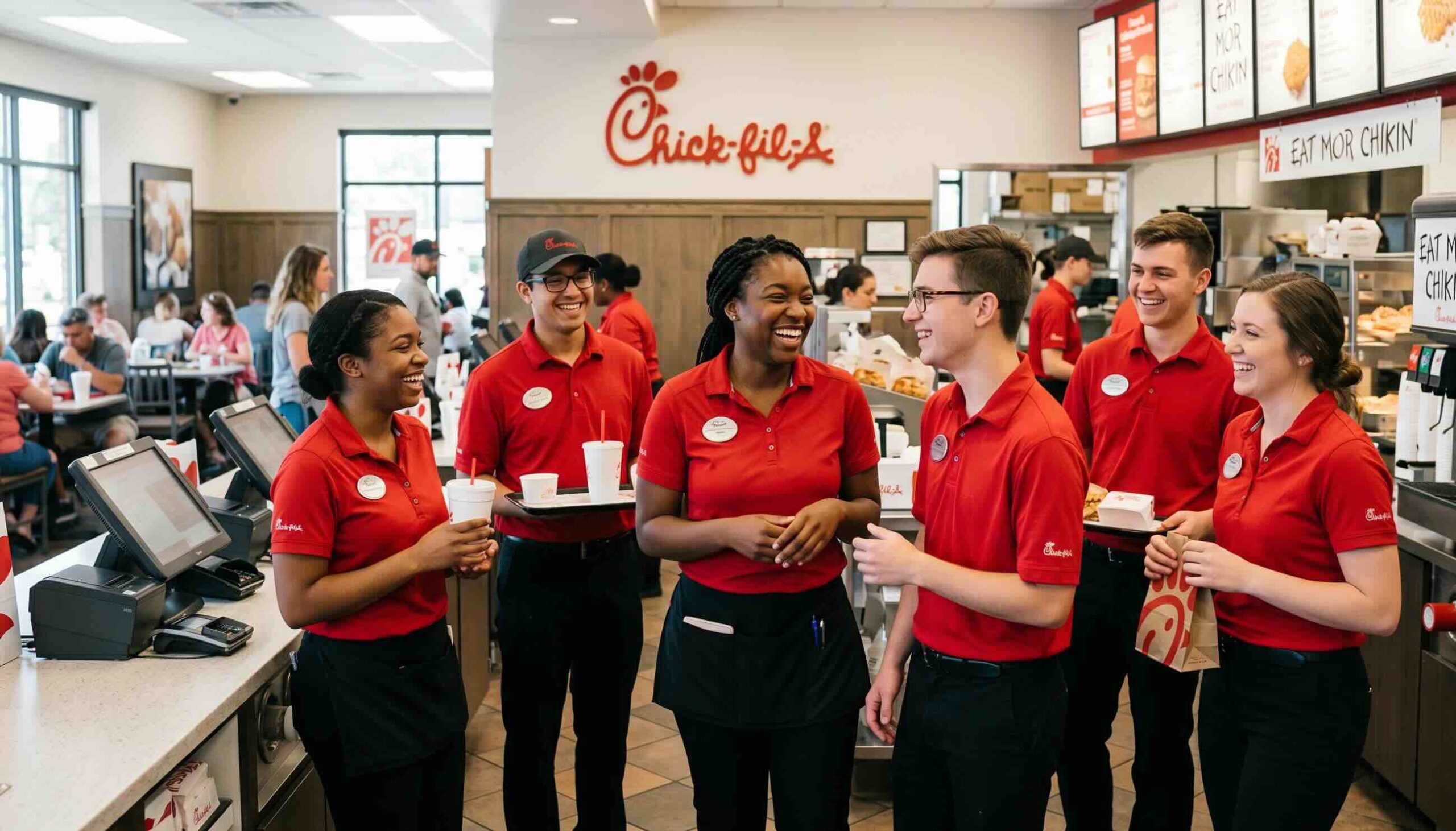
In 2023, Chick-fil-A generated roughly $21.6 billion in system-wide sales across about 3,000 locations. McDonald’s, operating more than 13,000 U.S. locations, pulled in around $48 billion domestically. Do the math: Chick-fil-A averages somewhere north of $8 million in annual revenue per restaurant. McDonald’s averages closer to $3.7 million. Chick-fil-A is closed every Sunday. It does not have a loyalty hack for that. There is no algorithmic workaround. The company simply accepts losing roughly 14% of potential operating days every year and still laps the industry on a per-unit basis.
That is not an accident. It is a system built deliberately over seven decades, rooted in one man’s conviction that how you build a business matters as much as what you build.
The Founder Who Built a Diner in a Basement
Truett Cathy opened the Dwarf Grill in Hapeville, Georgia in 1946. He was 25 years old, fresh out of the Army, and operating a 24/7 diner across the street from a Ford assembly plant. He learned the restaurant business by grinding: open around the clock, serve the shift workers, stay alive on thin margins.
Then, in 1960, his brother Ben died in a plane crash. Truett closed the restaurant the following Sunday, partly out of grief, partly out of a personal conviction rooted in his Baptist faith. He did not reopen on Sundays after that. The practice stuck, and when he began franchising Chick-fil-A in 1967 through mall food courts, the Sunday closure came with it. Non-negotiable.
Cathy was not naive about the cost. He simply believed that a business built on clear values would attract people who shared them, and that those people would build something stronger than any individual policy could explain. That bet has compounded for 60 years.
The Franchise Model Nobody Else Is Running
Chick-fil-A does not call its operators franchisees. The distinction is not semantic. In a traditional fast food franchise, the owner pays a large upfront fee (often $500,000 to $2 million or more), secures their own real estate, finances their own construction, and owns the physical location. They take on significant financial risk in exchange for brand rights and a supply chain.
Chick-fil-A’s model flips that entirely. The company owns every restaurant. It selects operators, charges them a $10,000 buy-in, and hands them the keys to a fully built, corporate-funded location. In exchange, Chick-fil-A takes 15% of top-line sales plus 50% of pre-tax profit. The operator keeps the other 50%.
The financial terms are punishing compared to conventional franchising, but the barriers to entry are radically lower. A capable operator with $10,000 and the right attitude can run an $8 million-per-year business. That makes the operator selection process the actual product. Chick-fil-A receives more than 60,000 applications per year for roughly 100 to 150 new operator slots. The acceptance rate is below 1%, making it statistically harder to become a Chick-fil-A operator than to get into Harvard.
What they are selecting for is not business acumen alone. They are selecting for people who will model the culture at the ground level, who will treat the Sunday closure as a feature rather than a bug, and who will implement the service standards that make customers return six days a week instead of seven.
If you are at the stage of structuring your own business entity before chasing growth, it is worth getting the legal foundation right early. Services like Northwest Registered Agent or LegalZoom can help you set up an LLC or corporation without burning weeks on paperwork before you build anything real.
Why Sunday Closures Are a Competitive Advantage
On the surface, closing one day a week looks like a self-imposed handicap. In practice, it functions as a brand signal, an operational reset, and a recruiting filter all at once.
Brand Signal
Constraints tell a story. When a company voluntarily gives up revenue to honor a principle, it communicates that its values are real rather than decorative. Customers notice. The Sunday closure has generated more earned media, word-of-mouth, and cultural conversation than most fast food chains could buy with a significant marketing budget. Every time someone says “I was craving Chick-fil-A and they were closed,” that is a brand impression. Desire amplified by scarcity.
Operational Reset
Restaurant equipment takes a beating six days a week. Staff get a guaranteed day off, which reduces turnover in an industry with notoriously high churn. Managers have a day to restock, plan, and think. Chick-fil-A locations tend to run tighter operations partly because the people inside them are not running on empty every day of the week. The closure is baked into the culture as a rhythm, not a disruption.
Recruiting Filter
People who apply to work at or operate a Chick-fil-A know the deal before they walk in. Anyone who resents working in a values-driven environment, or who needs Sunday shifts to make ends meet, typically self-selects out. What remains is a team that has opted in to the model, which changes the baseline energy of every location before management does a single thing.
The Service Culture That Actually Moves Numbers
Chick-fil-A has topped the American Customer Satisfaction Index (ACSI) for the fast food category multiple years running. The specific behaviors that drive those scores are not complicated. They are just rigorously maintained.
Employees are trained to say “my pleasure” rather than “you’re welcome” or “no problem.” The phrase was reportedly adopted after Truett Cathy noticed it being used at a Ritz-Carlton and felt it conveyed a fundamentally different orientation: service as privilege, not obligation. That one word swap is a proxy for everything else in the culture. It signals that the company has thought carefully about the experience at the micro level.
Chick-fil-A locations regularly run mobile order stations and face-to-face order-taking simultaneously in drive-through lanes to cut wait times. The company was processing double drive-through lanes and “face-to-face ordering” well before the pandemic forced the rest of the industry to get creative about throughput. They were not reacting to a crisis. They were executing a service philosophy that had been in place for decades.
The result: faster service, higher satisfaction scores, and some of the highest drive-through throughput in the industry, according to data from QSR Magazine’s annual drive-through report. All of this from a chain that is closed roughly 52 days per year that its competitors are open.
This mirrors what you see in the playbooks of operators like Leila Hormozi, who argues that culture is not a vibe; it is a system of explicit standards replicated at scale. The mechanism is the message.
Culture as the Actual Product
Most fast food chains compete on menu, price, convenience, and location density. Chick-fil-A competes on all of those too, but the primary product is the experience of being in one of their restaurants. That experience is manufactured deliberately through training, operator selection, and a set of values that have remained remarkably stable since the 1960s.
Truett Cathy ran Chick-fil-A as a private, family-owned company. The Cathy family has repeatedly declined acquisition offers and resisted going public. That decision has insulated the company from the quarterly earnings pressure that forces most publicly traded chains to cut corners on labor, quality, or service. The patience of private ownership is itself a structural advantage.
Dan Cathy, Truett’s son and CEO until 2021, continued that orientation. Andrew Cathy, the current CEO and third-generation leader, has maintained the private structure and the Sunday closure. The values have not drifted because the ownership has not changed hands.
For anyone building a team-dependent business, getting the internal operating infrastructure right early pays compounding dividends. Tools like Google Workspace make it easier to systemize communication, onboarding docs, and team processes before complexity forces you to improvise.
What the Numbers Actually Say
A few data points worth anchoring:
- Average Chick-fil-A unit volume: approximately $8.1 million annually (2023)
- Average McDonald’s unit volume: approximately $3.7 million (2023)
- Average Starbucks U.S. store revenue: approximately $1.7 million (2023)
- Chick-fil-A total U.S. locations: roughly 3,000
- McDonald’s total U.S. locations: roughly 13,500
- Chick-fil-A operator acceptance rate: under 1%
- Chick-fil-A operator buy-in: $10,000
That last contrast is the most striking. The chain with the lowest buy-in and the tightest operator selection produces the highest per-unit revenue in the industry. The correlation between selectivity and performance is not a coincidence.
For context on what disciplined brand-building looks like across different industries, the business book library at Hustlers Library covers several titles that break down how culture compounds into competitive moats: “Setting the Table” by Danny Meyer is one of the most relevant reads in this space.
Steal This
Here are the specific principles Chick-fil-A runs on that you can apply to whatever you are building:
1. Constraints Are Brand Signals
A voluntary limit tells your market that your values are real. Closing Sundays communicates more about Chick-fil-A’s identity than any marketing campaign could. What constraint could you adopt that would signal your values and filter for the right customers, employees, or partners?
2. Selection Is the Product
Chick-fil-A’s quality control lives in the operator selection process, not in a corporate audit team. When fewer than 1% of applicants make it through, the output is almost predetermined. Who you let in is more important than most operational systems you will ever build.
3. Ownership Structure Determines Time Horizon
Staying private let the Cathy family play a decades-long game while publicly traded competitors chased quarterly metrics. If you can avoid selling control early, you keep the ability to make long-horizon decisions that compound in ways short-term shareholders will not tolerate.
4. Culture Lives in the Details, Not the Deck
“My pleasure” is a two-word script change that encodes an entire service philosophy. Culture does not live in the values poster in the break room. It lives in the specific behaviors you require, train for, and enforce consistently at the micro level. Find your version of “my pleasure.”
5. Skin in the Game, Not Capital in the Game
The $10,000 operator buy-in is deliberately low. Chick-fil-A is not selecting for people with capital. It is selecting for people with commitment. There is a lesson here for how you structure partnerships, equity splits, and early hiring: align with people who are bought in on the mission, not just the upside.
Ready to Know Where You Stand?
The Business Journey dashboard maps your exact position across all 13 stages. Track your progress, unlock resources for each step, and build with a framework used by thousands of founders at Hustler's Library.

No credit card required · Takes 3 minutes · Personalized to your stage