The red-eye is one of those travel moves that looks brutal on paper and is either brilliant or terrible depending on how you execute it. Fly overnight from LA to New York, skip the hotel, show up for a 9 AM meeting, save $200 on a fare, and look like you have your act together. Or show up disoriented, wrinkled, and unable to string a sentence together. The difference is knowing when to book one and what to do when you do.
The Business Case for Red-Eye Flights
You Save a Hotel Night
This is the clearest financial argument. A one-way red-eye from LAX to JFK departing at 11 PM and arriving at 7 AM replaces an evening hotel stay in Los Angeles or an early morning in New York. At $200-400 per hotel night in major business cities, the math is straightforward. Even if the red-eye costs $50-100 more than a daytime fare (it usually doesn’t), you’re still ahead on total trip cost.
Cheaper Fares
Red-eye fares are often 15-40% cheaper than the equivalent daytime route, especially on popular business corridors like LAX-JFK, SFO-JFK, SEA-BOS, and the west-to-east runs that see heavy daytime demand. If you’re booking last-minute, overnight departures frequently have more availability at lower price points because leisure travelers avoid them.
You Arrive Ready to Work
On a well-executed red-eye, you board, sleep, land, freshen up, and go directly to your first meeting. You haven’t lost a working day to travel. You haven’t spent five hours sitting in airports when you could have been productive. The entire travel leg happens while you’d be sleeping anyway.
Less Turbulence and Quieter Cabins
Thermal activity that creates turbulence is much lower at night. Cabins are quieter. Most passengers aren’t talking. The flight experience itself is often more pleasant than midday travel, particularly on busy routes.
When Red-Eyes Don’t Make Sense
The red-eye is not always the right call. Here’s when to skip it:
- You have an important morning meeting on arrival. If you can’t sleep sitting up reliably, showing up at a high-stakes pitch or negotiation on zero real sleep is a bad trade. The hotel night is worth it.
- Eastward long-haul flights. A domestic red-eye (U.S. west coast to east coast) works because it’s a 5-hour flight and you cross 3 time zones. A transatlantic or transpacific red-eye heading east adds jet lag on top of sleep deprivation. That combination is genuinely brutal and requires extra recovery time.
- You physically cannot sleep upright. If you have never successfully slept on a plane and don’t have a lie-flat business class seat, the red-eye is just a regular overnight flight where you didn’t sleep. Know yourself.
- The next 48 hours are dense with critical work. If you have back-to-back client meetings, negotiations, or events, the accumulated sleep deficit will catch up with you. One bad night can degrade performance for two days.
- You’re recovering from illness or already sleep-deprived. The red-eye compounds existing fatigue. It’s not a reset.
By the Numbers
- Average domestic red-eye discount vs. daytime fare on same route: 15-40%
- Typical hotel savings by skipping one night: $150-400 depending on city
- Working hours recovered by flying overnight vs. daytime: 4-8 hours (your day is intact)
- Cabin humidity on overnight long-haul flights: 10-20% (dehydration risk is real)
- Best domestic red-eye corridors by traveler volume: LAX-JFK, SFO-JFK, SEA-BOS, LAX-MIA, LAX-ORD
- Ideal melatonin timing for forcing sleep on a red-eye departure: 30-60 minutes before desired sleep onset (per sleep research, not a dosing recommendation)
How to Optimize Your Red-Eye: Seat Selection
Always Book a Window Seat
The window seat is non-negotiable on a red-eye. You have a wall to lean against, no one climbing over you to use the bathroom, and full control over the window shade. You can create your own dark sleep environment without depending on anyone else’s preferences. Middle and aisle seats on overnight flights mean interrupted sleep every single time your row neighbor needs to move.
Best Rows on Common Aircraft
- Boeing 737 / Airbus A320 family: Avoid the last few rows (seats don’t recline near the lavatory, and it’s noisier). Rows 10-20 in economy are the sweet spot. Emergency exit rows give more leg room but the seats may not recline.
- Boeing 757: Commonly used on domestic red-eye routes. Rows further forward tend to be quieter; the rear galley can be disruptive on overnight flights.
- Larger aircraft (767, 777 on long-haul): Window seats in economy plus or premium economy give more recline and better sleep surfaces for overnight flights. The investment in premium economy on a truly long red-eye is often worth running the numbers on.
Use SeatGuru (seatguru.com) before every booking to check the specific aircraft layout for your flight. Aircraft configurations change and a seat that’s great on one variant of a plane is uncomfortable on another.
The Sleep Kit: What You Actually Need
You don’t need a luxury travel kit. You need the specific items that solve the actual problems with sleeping in a plane seat:
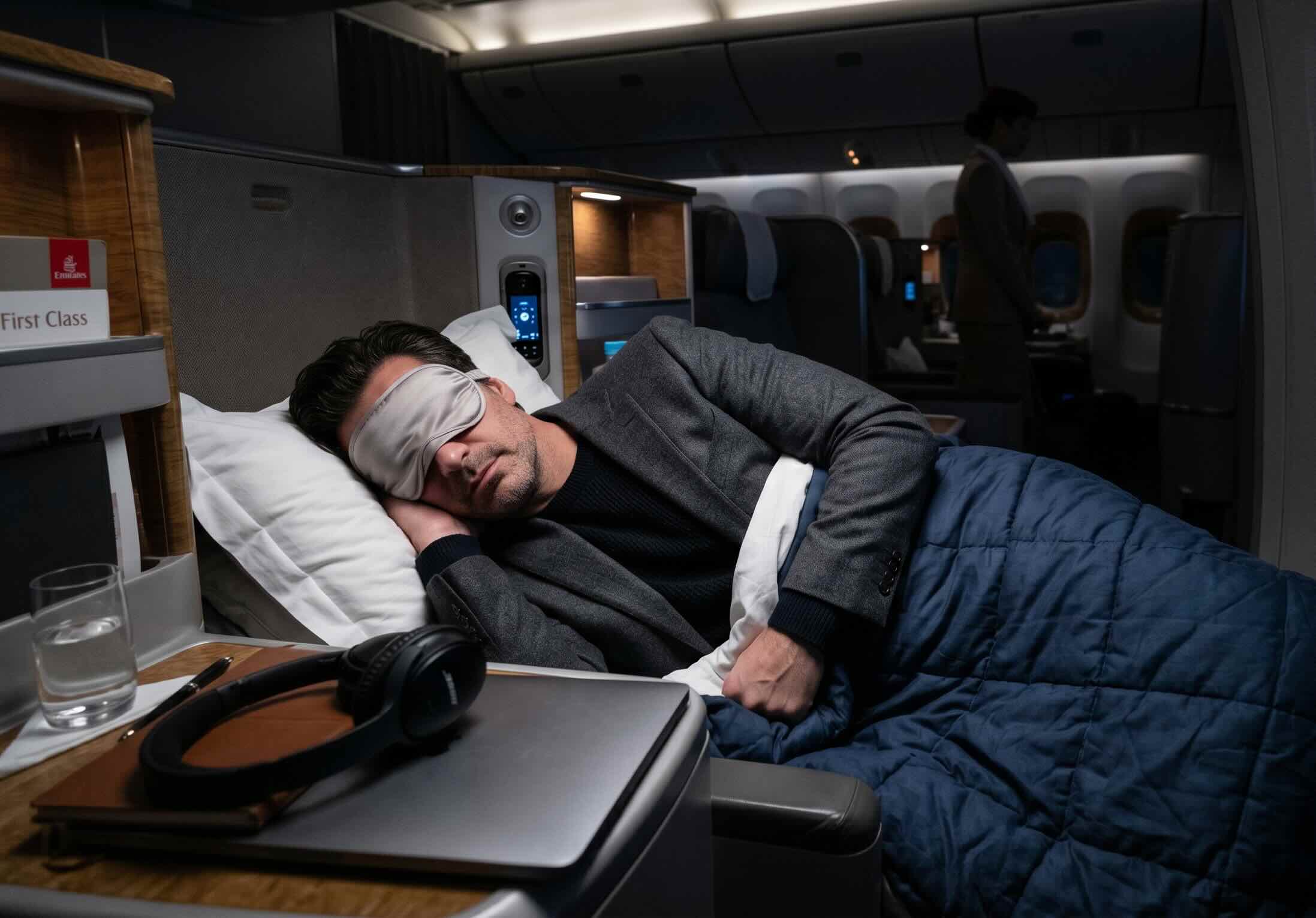
- Sleep mask: Not optional. Cabin lights, screen glow from other passengers, and sunrise can all disrupt sleep. A contoured mask that doesn’t press on your eyes is worth the extra $10-20 over a flat foam option.
- Noise-canceling headphones or earplugs: Headphones are better because they cancel low-frequency engine noise that earplugs don’t block. If you’re already carrying headphones for work, they double as your sleep gear.
- Neck pillow: A good memory foam U-shaped neck pillow prevents the head-bobbing problem that wakes you up every 20 minutes. The inflatable travel variety compresses well. The Trtl pillow (wraps like a scarf) is popular for window seat travelers specifically.
- Compression socks: Sitting in a pressurized cabin for hours with reduced activity increases risk of blood pooling in the legs. Compression socks improve circulation and reduce that heavy-leg feeling on arrival. Wear them on every flight over 4 hours.
- Lip balm and a small moisturizer: Dry cabin air desiccates skin and lips, which contributes to the “I slept on a plane” look you’re trying to avoid at the morning meeting.
Eat and Drink Strategy
What to Avoid
- Alcohol: Fragments sleep quality, dehydrates you at altitude, and makes arrival feel worse. Same principle as with jet lag management: the short-term relaxation effect costs you hours of sleep quality.
- Heavy meals before boarding: Digestion disrupts sleep onset. Eat a normal, moderate dinner before you leave for the airport.
- Caffeine after 4 PM on departure day: If your flight departs at 11 PM, a 3 PM coffee is fine. A 7 PM coffee is not. Caffeine’s half-life is 5-7 hours; it will still be partially active in your system at boarding time.
What to Prioritize
- Water: Hydrate aggressively before, during, and after the flight. Drink a full glass before boarding and ask for water at least once per hour on overnight flights.
- Light snack if hungry at boarding: A small, carbohydrate-forward snack can mildly promote sleep onset. Nothing heavy. Think crackers, a small piece of fruit, or a granola bar.
Best Red-Eye Routes by Airline
Not all red-eye routes are equal. The best domestic red-eyes in the U.S. tend to be on routes where airlines have invested in the overnight product:
- JetBlue: Strong on transcontinental red-eyes (LAX/SFO-JFK). Mint class (lie-flat) on select transcontinental routes is one of the best domestic overnight options at a price far below legacy carrier international business class.
- Delta: Good red-eye coverage on west-to-east corridors. Comfort Plus seats (extra legroom, more recline) are worth the upgrade on overnight domestic runs.
- United: Polaris business class on transcontinental routes where it’s deployed. Worth checking on SFO-EWR and LAX-EWR if you have a lie-flat seat requirement.
- Alaska Airlines: Strong on Pacific Northwest to East Coast red-eyes (SEA-JFK, SEA-BOS, PDX-JFK). First class on Alaska domestically is reasonably priced and significantly more comfortable for sleeping.
If you’re evaluating whether the upgrade to business or premium economy makes sense on a red-eye specifically, check our detailed breakdown of when the business class upgrade actually makes financial sense. Short version: on a red-eye, the case for upgrading is stronger than on any other flight type because sleep quality is directly tied to the seat.
The Day After: Recovery Without Losing Productivity
You landed at 7 AM. The meeting went well. Now you have the rest of the day. Here’s how to structure it:
- Shower immediately on arrival. Even a quick 5-minute shower resets your alertness and removes the “just got off a plane” feeling faster than anything else.
- Get outside for morning light. Natural daylight anchors your circadian clock and suppresses residual sleepiness better than caffeine alone.
- Front-load your hardest work. You’ll be functioning reasonably well in the morning hours post-red-eye. Schedule anything requiring real concentration for morning, not afternoon.
- A 20-minute nap in early afternoon is fine. Set an alarm. Twenty minutes won’t put you into deep sleep and won’t affect your ability to sleep at normal bedtime that night. More than 20 minutes creates sleep inertia (that groggy feeling on waking) and disrupts nighttime sleep.
- Caffeine strategically, not constantly. One or two focused coffee hits in the morning. Stop before early afternoon. You want to sleep normally that night.
- Sleep at a normal local time that evening. This is the full reset. Don’t crash at 6 PM.
For a broader system for managing travel days without losing your edge, our post on how to travel for business without losing productivity covers the full workflow. And for the airport experience before you even board the red-eye, check out our guide to the best airport lounges for business travelers: a quiet lounge before a late departure is a legitimate performance advantage.
Key Takeaways
- Red-eyes make financial sense when they save a hotel night, reduce fare cost, and preserve your working day. Run the numbers each time.
- They don’t make sense when you have a critical morning meeting on arrival, can’t sleep upright, or are doing eastward long-haul where jet lag compounds the sleep debt.
- Always book window seats. Walls to lean on, no bathroom traffic, full control of light.
- Core sleep kit: contoured sleep mask, noise-canceling headphones or earplugs, quality neck pillow, compression socks.
- Avoid alcohol and late caffeine. Hydrate aggressively. Eat light before boarding.
- JetBlue Mint, Alaska First, Delta Comfort Plus, and United Polaris are the best domestic overnight seat options.
- Day-after protocol: shower immediately, get morning light, front-load hard work, 20-minute nap maximum, sleep at normal local time that night.
Sources & Further Reading
- Sleep Foundation: Sleep Hygiene and Travel
- FAA: Jet Lag and Fatigue Guide for Travelers
- SeatGuru: Aircraft Seat Maps and Reviews
- Hustler’s Library: Best Airport Lounges for Business Travelers
Want more content like this? Join Hustler’s Library free and get access to our full entrepreneur resource vault.
Ready to Know Where You Stand?
The Business Journey dashboard maps your exact position across all 13 stages. Track your progress, unlock resources for each step, and build with a framework used by thousands of founders at Hustler's Library.

No credit card required · Takes 3 minutes · Personalized to your stage