You flew 14 hours to close a deal worth six figures. You landed at 7 AM, your meeting is at 10 AM, and your brain is still somewhere over the Pacific. You’re nodding at things you’re not sure you agreed to, struggling to do mental math you could do in your sleep at home, and making a first impression that doesn’t reflect what you’re actually capable of. Jet lag is a business problem, and most entrepreneurs treat it like a weather condition you just endure. It isn’t. Here’s how to manage it.
The Science, Briefly
Your circadian rhythm is a roughly 24-hour internal clock that regulates sleep, alertness, hormone release, metabolism, and dozens of other biological functions. It’s synchronized primarily by light exposure, specifically the light that hits your retinas and signals your suprachiasmatic nucleus (the brain’s master clock) to adjust cortisol and melatonin production.
When you cross time zones rapidly, your internal clock is still set to your home timezone while the external environment (daylight, meal timing, social cues) is on a completely different schedule. The result is a mismatch that takes the body time to resolve, typically 1-1.5 days per time zone crossed to fully readjust. Fly from New York to Tokyo (14 time zones) and you’re theoretically looking at 14+ days to fully reset without intervention.
The key variables:
- Adenosine: A chemical that builds up in the brain the longer you’re awake, creating sleep pressure. Crossing time zones disrupts when adenosine cycles are high vs. low relative to actual clock time.
- Melatonin: Produced by the pineal gland in response to darkness, melatonin signals “time to sleep.” Jet lag disrupts the timing of this signal.
- Cortisol: Your alertness and stress hormone, normally peaking in the morning and declining through the day. When you cross time zones, cortisol peaks at the wrong time.
Why Eastward Travel Is Harder
This is not subjective. Flying east is biologically harder than flying west for most people, and there’s a clear reason: your internal clock naturally runs slightly longer than 24 hours (closer to 24.2 hours). That means it’s slightly easier to extend your day (westward travel) than to shorten it (eastward travel). When you fly east, you’re forcing your body to advance its clock, which goes against its natural drift. When you fly west, you’re letting it extend, which is more natural.
Practical implication: if you’re flying New York to London (5 time zones east), expect more difficulty than London to New York (5 time zones west). Plan your schedule accordingly.
By the Numbers
- Time zones where jet lag becomes significantly disruptive: 3+ zones
- Estimated recovery rate without intervention: 1 to 1.5 days per time zone crossed
- New York to London: 5 time zones east, potential 5-7 day full recovery
- Los Angeles to Tokyo: 17 time zones (or 7 going west), best route is westward
- Melatonin research-supported dose range for circadian shifting: 0.5mg to 5mg (per studies cited by Harvard Medical School sleep research)
- Alcohol impact on sleep quality: reduces REM sleep by up to 24% even in moderate amounts
- Cabin humidity on long-haul flights: typically 10-20%, compared to 30-60% at sea level
The Protocol: Before You Leave
The most underutilized jet lag strategy is starting your adjustment 2-3 days before departure. Here’s how:
For Eastward Travel (e.g., U.S. to Europe)
- Move your bedtime 30-60 minutes earlier per night for 2-3 nights before departure
- Wake up earlier accordingly and get bright light exposure first thing in the morning
- Take a small dose of melatonin (0.5mg-1mg, per circadian biology research) 60-90 minutes before your new target bedtime
For Westward Travel (e.g., U.S. to Asia via westward routing)
- Push your bedtime slightly later in the days before departure
- Delay morning light exposure using blackout curtains or a sleep mask
Even a 1-2 hour pre-shift significantly reduces the adjustment burden at your destination.
On the Flight
Skip the Alcohol
This one is non-negotiable. Alcohol may help you fall asleep faster, but it fragments sleep quality significantly. Research published in the journal Alcoholism: Clinical and Experimental Research found that even moderate alcohol consumption reduces REM sleep and increases nighttime waking. On a flight where sleep quality is already compromised by the cabin environment, altitude, and noise, alcohol makes everything worse. Drink water and electrolytes instead.
Manage Light Aggressively
Light is the most powerful signal your circadian clock receives. If you need to sleep on the flight, block light completely with a quality sleep mask. If you need to stay awake to sync with your destination timezone, expose yourself to light (window seat, cabin lighting, or a portable light therapy device). The timing of light exposure determines whether you shift your clock earlier or later.
Hydration and Cabin Pressure
Cabin air is extremely dry, typically 10-20% relative humidity vs. 30-60% at ground level. Dehydration amplifies fatigue and cognitive impairment. Drink at least 8 oz of water per hour of flight. Avoid excessive caffeine, which is both dehydrating and will disrupt sleep if you’re trying to nap on the flight.
Sleep on Destination Time
Set your watch to destination time when you board. If it’s nighttime at your destination, try to sleep on the flight regardless of what time it is at home. If it’s daytime at your destination, stay awake. This is the core principle of adjusting in transit rather than waiting until you land.
Tools That Actually Work
Timeshifter
Timeshifter is an app built on the circadian science research of Dr. Steven Shea and his team. You input your flight details and sleep preferences, and it generates a personalized light exposure, sleep, caffeine, and melatonin timing protocol. It’s the closest thing to having a sleep scientist review your itinerary. The app costs around $24.99/year, which is borderline free compared to the cost of showing up impaired to a business trip.
f.lux and Blue Light Blocking
f.lux is a free desktop app that automatically adjusts your screen’s color temperature based on time of day, reducing blue light in the evening to support melatonin production. Pair it with blue light blocking glasses for evening device use in the days before and after travel. It’s a small intervention with a measurable effect on sleep onset timing.
Melatonin Timing
Research from Brigham and Women’s Hospital and the Harvard Division of Sleep Medicine suggests that low-dose melatonin (0.5mg-3mg) taken at the appropriate destination bedtime can accelerate circadian adjustment. The key is timing: taken at the wrong time relative to your circadian phase, melatonin can shift your clock in the wrong direction. Use Timeshifter or consult a sleep specialist to get the timing right for your specific itinerary.
The First 24 Hours at Your Destination
How you handle the first day largely determines how quickly you recover:
- Get outside immediately. Natural daylight is the most powerful circadian reset available. Even 30 minutes of outdoor light exposure in the morning at your destination accelerates adjustment.
- Eat on local time. Meal timing is a secondary zeitgeber (time cue) for your circadian clock. Eating breakfast at local breakfast time helps anchor your body to the new timezone.
- Avoid naps longer than 20 minutes if it’s before your destination bedtime. Long naps reduce sleep pressure (adenosine buildup) and make it harder to fall asleep at the right time that evening.
- Push through to local bedtime if at all possible on the first night. A full night’s sleep at local time is the single fastest reset.
- Schedule your first important meeting no earlier than your second full day in destination timezone. If your calendar forces a meeting on day one, account for impairment in your preparation.
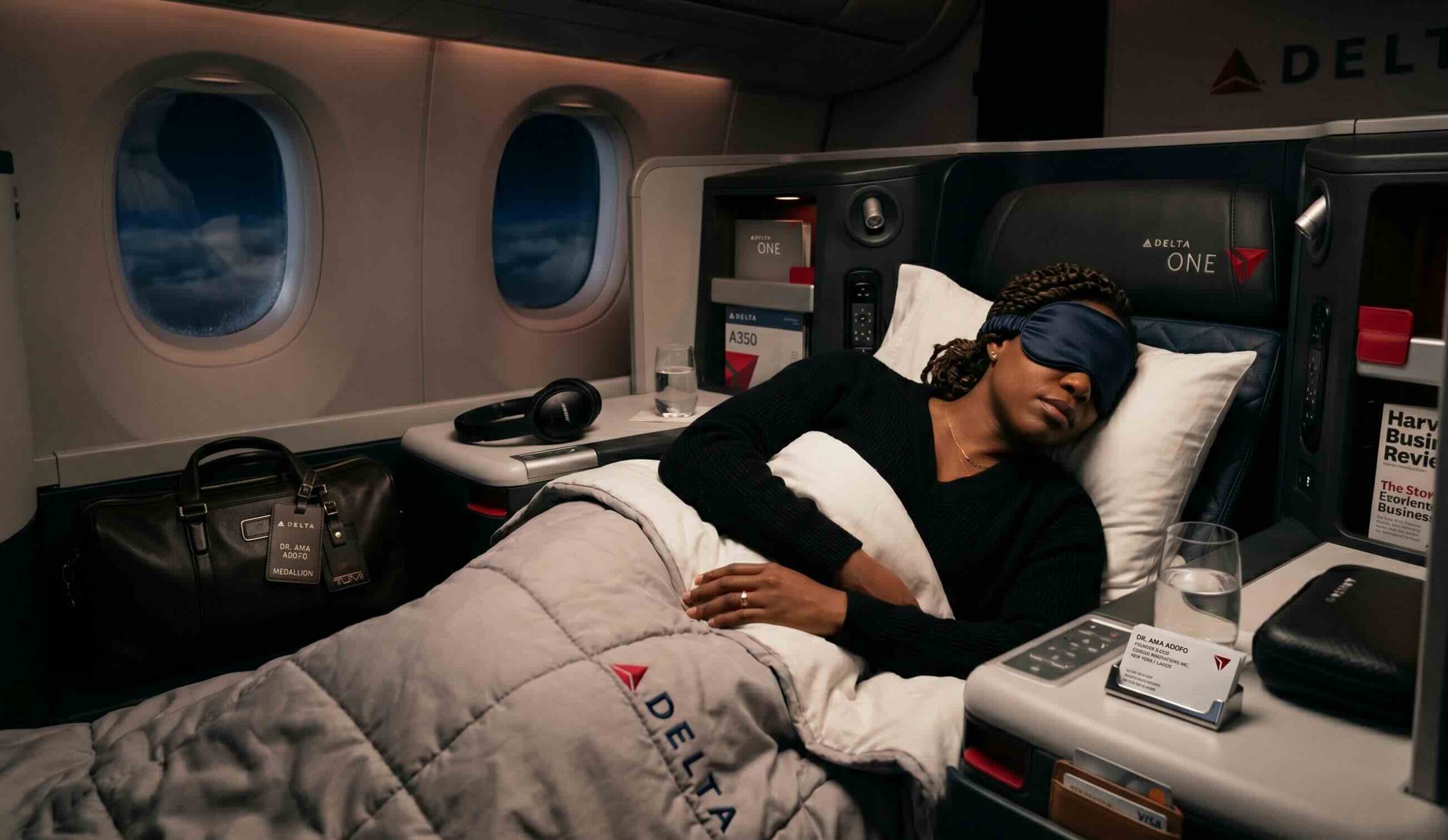
The goal isn’t just to feel okay. It’s to actually perform. For a full system on staying productive while traveling, read our guide on how to travel for business without losing productivity. And if you’re in premium cabins, the sleep environment is dramatically better: see our breakdown of when the business class upgrade actually makes sense.
Why This Is a Financial Issue, Not Just a Comfort Issue
Let’s be specific. You flew business class to Singapore for a partnership meeting. Round trip plus hotel: $8,000. You showed up tired, unfocused, and not at your best. The deal didn’t close. Or it closed on terms worse than you would have accepted if you’d been sharp. Or you made a commitment you later regretted because your executive function was compromised. The $25 Timeshifter subscription and the decision not to drink on the flight were not comfort choices. They were ROI decisions.
When you invest thousands of dollars in getting to a destination for business, the last optimization to cut corners on is sleep and performance management.
Key Takeaways
- Jet lag is a circadian rhythm disruption driven by light, adenosine, melatonin, and cortisol timing mismatches.
- Eastward travel is harder than westward: plan and prepare more aggressively for eastbound trips.
- Start adjusting 2-3 days before departure by shifting sleep timing toward destination time.
- On the flight: skip alcohol, hydrate aggressively, manage light exposure, and sleep on destination time.
- Melatonin at low doses (0.5mg-3mg) can help shift your clock, but timing is critical. Use Timeshifter for guidance.
- First 24 hours at destination: get outdoor light immediately, eat on local time, avoid long naps, push to local bedtime.
- Schedule important meetings on day two or later whenever possible.
- Jet lag management is a performance and financial investment, not a luxury.
Sources & Further Reading
- Harvard Health: Blue Light and Sleep
- NIH: Alcohol and Sleep Research (Alcoholism: Clinical and Experimental Research)
- Timeshifter: The Science Behind the App
- Hustler’s Library: Business Class vs. Economy
Want more content like this? Join Hustler’s Library free and get access to our full entrepreneur resource vault.
Ready to Know Where You Stand?
The Business Journey dashboard maps your exact position across all 13 stages. Track your progress, unlock resources for each step, and build with a framework used by thousands of founders at Hustler's Library.

No credit card required · Takes 3 minutes · Personalized to your stage