You want an automatic watch. You’ve done enough reading to know names like Seiko, Orient, and Tissot keep coming up at the entry level. But how do they actually compare? Which brand gives you the most watch for the money? And which one makes sense for your life as an entrepreneur — someone who needs a piece that works at a pitch meeting, a dinner, and a weekend away without overthinking it?
This isn’t a collector deep-dive or a watch forum argument. It’s a straight comparison of three brands that dominate the $150-$500 price range, written for someone who wants to wear a quality mechanical watch without spending $2,000 to get there.
The short answer: all three are legitimate. The long answer is below.
Why These Three Dominate the Entry Level
Seiko, Orient, and Tissot each built their reputation by doing something specific well. Seiko is the most prolific manufacturer in this tier, producing everything from $75 field watches to in-house movements that punch well above their price. Orient — now part of Seiko Epson — is the value leader, frequently offering the best movement-per-dollar ratio anywhere in horology. Tissot is the Swiss option in this bracket, carrying the credibility of Swiss Made certification and the backing of the Swatch Group.
None of these are watches that watch people sneer at. They’re respected across the enthusiast community precisely because they deliver honest mechanical watchmaking without financial pain.
If you want deeper context on what makes an automatic movement worth caring about, read our guide on how to buy your first automatic watch before diving into brand specifics.
Seiko: The Volume Champion
What You’re Getting
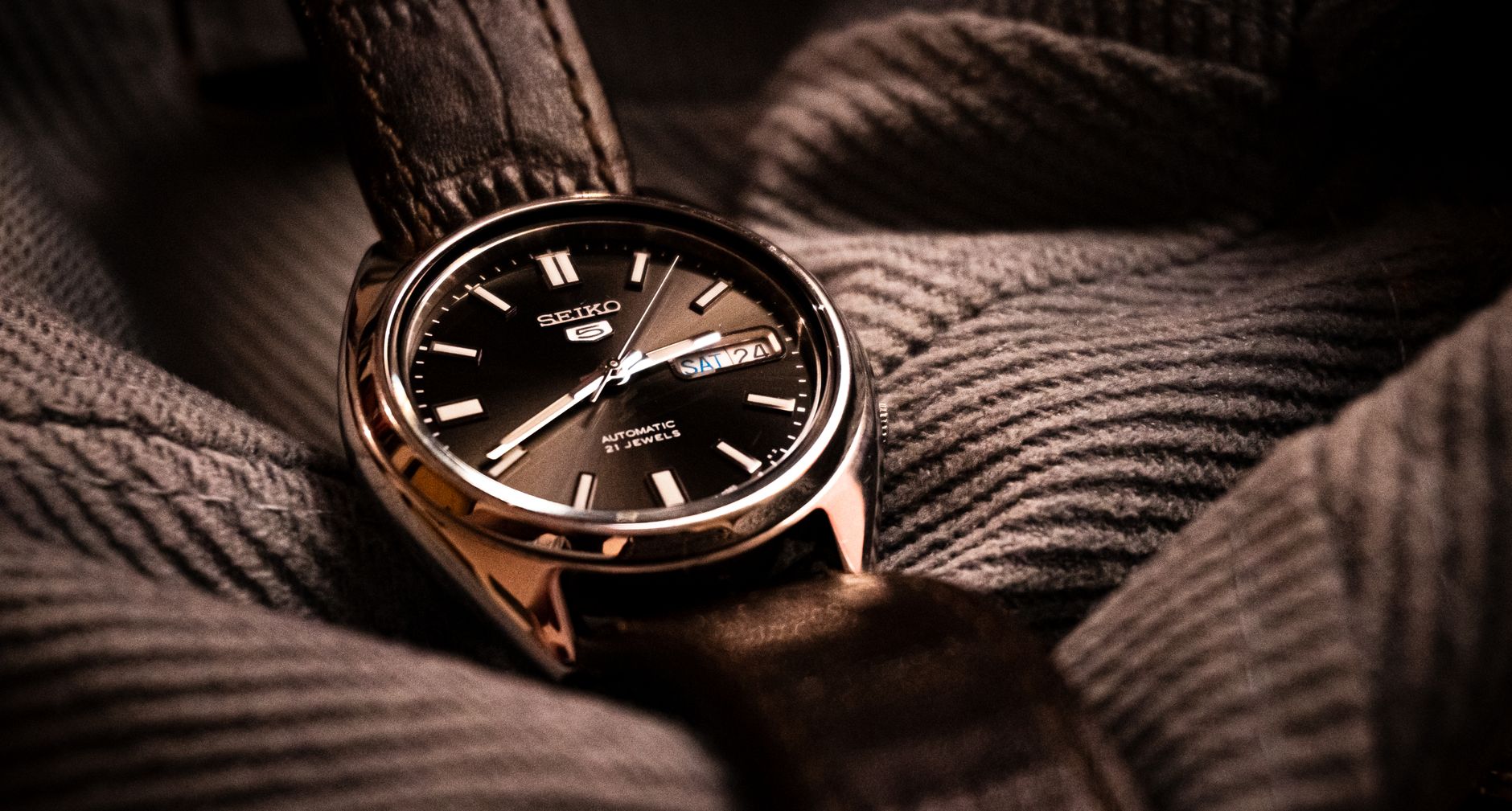
Seiko makes so many watches that it can be paralyzing. The lineup includes five sub-brands relevant to this conversation: 5 Sports (affordable sport automatics), Presage (dressy dial-forward pieces), Prospex (dive and field), and the higher-end Presage Sharp Dressed Man series. For entry-level buyers, the Seiko 5 Sports collection and the Presage lineup are where you start.
The workhorses here are the 4R35 and 4R36 movements. These are reliable, serviceable, and accurate to roughly +/- 15 seconds per day — which is typical for this price point. The newer NHxx series movements (NH35, NH36) are hacking and hand-winding capable, which matters if you want to set your watch precisely. The Seiko 5 Sports SRPD55 and SRPD57 are perennial recommendations in this tier, running around $200-$260 retail.
If you step up to Presage, the SPB series delivers much better dials — think applied indices, sunburst lacquer finishes, and exhibition casebacks — typically in the $350-$500 range. The Presage Sharp Dressed Man series (SRPJ41, SRPJ43) is one of the best-looking watches available under $500, full stop.
The Trade-Offs
The biggest knock on Seiko is quality control inconsistency. You’ll find perfectly finished watches alongside examples with slightly off crown alignment or minor dial printing imperfections — it’s the downside of high volume manufacturing. Their movements also generally run wider tolerances than Tissot’s ETA/Powermatic 80 equipped pieces.
Seiko’s bracelets in the sub-$300 range are functional but hollow-feeling. If you buy a Seiko 5, plan on either a leather strap or a third-party steel bracelet to get the full experience. Seiko 5 Sports on Amazon
Orient: The Value Leader
What You’re Getting
Orient is where you go when you want the most mechanical watch for the least money. They produce their own in-house movements — the F6922, F6724, and others — which is unusual at this price point. Most of the competition (including Seiko in some models) uses movements designed for them. Orient designs and manufactures theirs internally, which is a serious engineering credibility point that often gets overlooked.
The Orient Bambino series is the flagship recommendation for entrepreneurs looking for a dress watch. The Bambino V4 runs around $130-$160 and is genuinely difficult to fault at that price: clean dial, domed crystal, 40mm case size that fits most wrists well. The Orient Star line (not to be confused with regular Orient) steps up to sapphire crystal and better finishing, typically $300-$500.
Orient also makes the Mako and Ray for dive-adjacent sport watches, and the Kamasu is a solid Submariner-ish option under $200.
The Trade-Offs
Orient’s movements run a bit less accurate than Tissot’s — expect +/- 15-20 seconds per day on average, though good examples often do better. Their mineral crystal on base models scratches easily; if you go Orient, seriously consider a crystal replacement or step up to the Star models with sapphire. The Bambino’s flat mineral crystal looks great but you’ll notice micro-scratches within a few weeks of daily wear.
That said, at $130, a scratched Bambino is a $130 problem. That’s a different category of concern than scratching a $500 piece.
Tissot: The Swiss Credibility Play
What You’re Getting
Tissot is the most expensive of the three but it’s also the most immediately legible as a “real” watch to non-enthusiasts. The Swiss Made designation still carries weight in business settings. When someone at a meeting glances at your wrist and sees the Tissot name, they register it as a proper watch — it hits differently than a Seiko 5 regardless of what you and I know about movement quality.
The Tissot PRX Powermatic 80 ($495-$595) is the poster child for this tier right now. It’s an integrated bracelet design with a clean, Patek-ish aesthetic and the Powermatic 80 movement offering 80 hours of power reserve and +/- 4 seconds per day average accuracy. That accuracy spec is genuinely exceptional for this price range — it comes from the Eta 2824 base, heavily regulated by ETA’s partner Sellita for Swatch Group.
The Tissot Le Locle ($450-$550) is the traditional dress play: tank-style case, beautifully decorated movement visible through the caseback, Roman numerals. It’s the watch you wear to a client dinner when you want to look like you’ve thought about what’s on your wrist.
The Tissot T-Classic Tradition series starts around $200 and offers a clean entry point into the brand without reaching for the PRX.
The Trade-Offs
You’re paying a premium for Swiss Made, heritage marketing, and that accuracy spec. A Tissot PRX at $495 gives you a great watch. An Orient Star at $350 gives you a great watch that costs $145 less. The value calculus shifts based on who you’re wearing it around and what you’re trying to signal.
Tissot bracelets are solid but some models (particularly the Le Locle) have lug designs that limit aftermarket strap options. The PRX bracelet fits great but isn’t adjustable at home without the right tools. Tissot PRX on Amazon
Head-to-Head: Which Should You Buy?
Best First Automatic Under $200: Orient Bambino
If this is your first automatic and you want to keep the spend low while getting a genuinely nice piece, the Orient Bambino V4 is the move. $130-$160, great dial, clean aesthetic, in-house movement. You’ll quickly understand why this watch wins beginner recommendation lists year after year. The mineral crystal will scratch — that’s the one downside. Either accept it or budget for an upgrade to the Orient Star version.
Orient Bambino V4 pricing: ~$130-$160 (check current prices here)
Best Sport/Casual Automatic Under $300: Seiko 5 Sports
The SRPD55 (SKX successor, field style) or SRPD87 (military dial) are the go-to picks in this category. They’re versatile, well-made, and have a massive aftermarket strap and parts community. If you want a watch that works at the gym, the office, the airport, and everywhere in between, Seiko 5 Sports wins this bracket.
Seiko 5 Sports pricing: ~$200-$260 (check current prices here)
Best Upgrade Pick: Tissot PRX Powermatic 80
If you’re at $450-$595 and want something with genuine visual presence, the PRX is the right call. It looks more expensive than it is, keeps exceptional time, and the integrated bracelet design makes it feel like a premium piece immediately. It’s the watch you could wear to a Series A pitch and nobody — not even the partner who collects Nautiluses — is going to look at it sideways.
Tissot PRX pricing: ~$495-$595 (check current prices here)
The Honest Summary
Seiko wins on range and community. Orient wins on value per dollar. Tissot wins on accuracy, finishing, and brand legibility to non-watch people.
There’s no wrong answer here. All three are honest mechanical watches that will last decades with minimal maintenance (a service every 5-7 years, roughly $100-$200). The question is really about what you’re optimizing for: maximum watch per dollar (Orient), versatility with a cult following (Seiko), or polish and brand credibility (Tissot).
Once you’ve got your entry-level automatic sorted, the next natural gear upgrade for your carry is equally important. Our roundup of best minimalist wallets for entrepreneurs covers what to pair it with.
Whichever direction you go, you’re buying into something with real horological history behind it. That’s more than you can say for most things at these prices.
For a deeper look at what separates the next tier up — Hamiltons, Longines, and the $500-$1,000 sweet spot — check out our full guide to entrepreneur gear worth investing in for more context on how to think about the gear decisions that actually compound over time.
Ready to level up the rest of your setup? Join Hustler’s Library for free — get weekly insights on tools, gear, and strategies for serious entrepreneurs. Join free here.
Ready to Know Where You Stand?
The Business Journey dashboard maps your exact position across all 13 stages. Track your progress, unlock resources for each step, and build with a framework used by thousands of founders at Hustler's Library.

No credit card required · Takes 3 minutes · Personalized to your stage