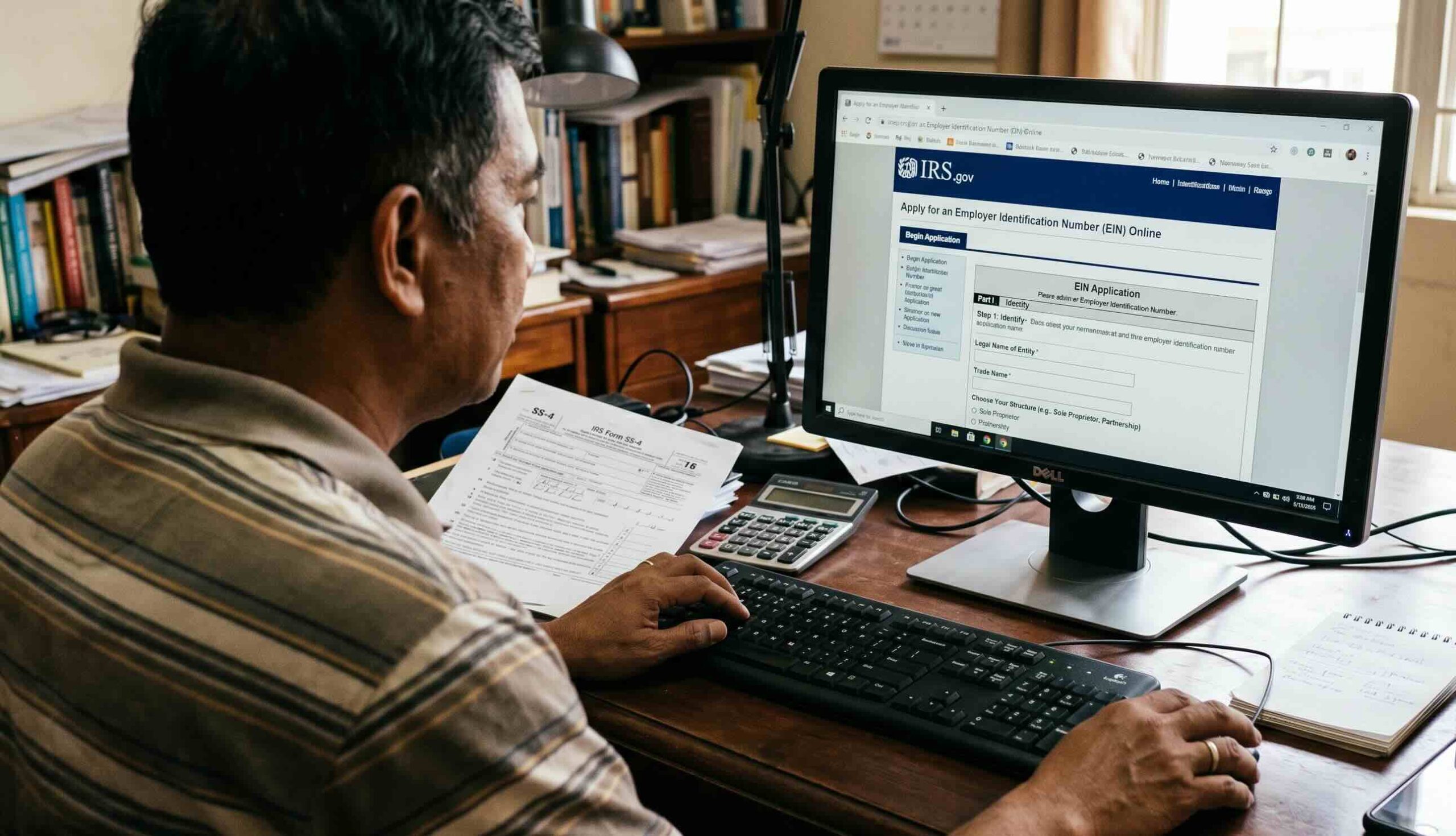
If you’re starting a business, opening a business bank account, or hiring your first employee, one of the first things you’ll encounter is the need for an Employer Identification Number. Understanding what it is, who needs it, and how to get it quickly can save you days of confusion and bureaucratic headaches.
Who This Is For: This guide is for new business owners, freelancers forming an LLC, entrepreneurs hiring their first employee, and anyone who has been asked for an EIN and isn’t sure what to do next.
- An EIN is a 9-digit federal tax ID assigned by the IRS
- It’s free to apply and can be obtained online in minutes
- Most businesses (and many sole proprietors) need one
- You can apply online, by fax, or by mail
- Online applications provide your EIN immediately upon completion
What Is an EIN?
An Employer Identification Number (EIN) is a unique nine-digit number assigned by the Internal Revenue Service to identify a business entity for tax purposes. It follows the format XX-XXXXXXX. Think of it as a Social Security Number for your business: it identifies your company to the federal government, to banks, and to other businesses you work with.
The IRS uses EINs to track tax obligations for businesses, nonprofits, trusts, estates, and other entities. Even if your business has no employees, you may still need one to open a bank account, apply for business licenses, or file certain tax returns.
EINs are also called Federal Employer Identification Numbers (FEIN) or Federal Tax Identification Numbers (TIN). These all refer to the same thing.
Who Needs an EIN?
The IRS requires an EIN for any business that meets at least one of these conditions:
- Has employees (including household employees like nannies)
- Operates as a corporation or partnership
- Files employment, excise, or alcohol/tobacco/firearms tax returns
- Withholds taxes on non-wage income paid to a non-resident alien
- Has a Keogh plan (a retirement plan for self-employed individuals)
- Is involved with certain trusts, estates, real estate mortgage investment conduits, nonprofits, farmers’ cooperatives, or plan administrators
Even if you’re a sole proprietor with no employees, you may want an EIN to protect your personal Social Security Number from being shared on invoices and tax forms.
| Business Type / Situation | Needs EIN? | Notes |
|---|---|---|
| LLC (single-member, no employees) | Recommended | Not required by IRS but often required by banks |
| LLC (multi-member) | Yes | Taxed as partnership by default |
| S-Corp or C-Corp | Yes | Always required |
| Sole Proprietor with employees | Yes | Required to run payroll |
| Sole Proprietor, no employees | Optional | Strongly recommended for privacy |
| Nonprofit organization | Yes | Required for 501(c) application |
| Trust or Estate | Yes | Required by IRS |
| Independent Contractor (1099) | Optional | Can use SSN but EIN protects privacy |
Get Your Business Entity Right First
Before you apply for an EIN, make sure your business entity is formed correctly. Your EIN is tied to your legal structure: if you apply as a sole proprietor and later form an LLC, you will likely need a new EIN. Getting the entity right before you apply saves you paperwork and potential IRS headaches down the road.
Which Structure Needs an EIN?
- Sole Proprietor (no employees): EIN optional, but recommended for privacy. You can file taxes using your SSN, but sharing your SSN on invoices and W-9s creates identity theft risk.
- Single-Member LLC: Not required by the IRS, but most banks require it. Apply before you try to open a business bank account.
- Multi-Member LLC: Required. The IRS treats multi-member LLCs as partnerships by default, and partnerships must have an EIN.
- S-Corp / C-Corp: Always required from day one.
- Partnership: Always required.
Forming Your LLC Before You Apply
If you haven’t formed your LLC yet, do that first. Two options worth knowing:
Northwest Registered Agent is a top registered agent service for LLC formation. They handle state filing, provide a registered address, and get your entity documents in order so your EIN application goes smoothly. Their privacy-first approach means your personal address stays off public state records.
LegalZoom is another solid option for business formation, particularly if you want access to on-demand legal support alongside your filing. Both services file your Articles of Organization with the state and give you the formation documents you’ll need before heading to the IRS.
Once your LLC is active and you have your Articles of Organization in hand, you’re ready to apply for your EIN. The whole process from entity formation to EIN can be completed in a single day if you use online services.
How to Apply for an EIN
The IRS offers four methods to apply for an EIN. Here’s a breakdown of each, including processing times:
1. Online (Fastest Method)
The IRS online EIN application is available Monday through Friday, 7 a.m. to 10 p.m. Eastern Time. The process takes about 15 minutes, and you receive your EIN instantly upon completion. This is the fastest and most convenient method for most business owners.
You can apply at the IRS EIN online application page.
Requirements: You must have a valid Taxpayer Identification Number (SSN, ITIN, or existing EIN) to complete the application. The responsible party must be an individual, not an entity (as of May 2019).
2. By Fax
You can complete Form SS-4 and fax it to the appropriate IRS fax number for your state. Processing time is typically 4 business days, after which the IRS will fax your EIN back to you. This is a good option if the online system is unavailable or if you’re an international applicant.
3. By Mail
Mail a completed Form SS-4 to the IRS address for your state. Processing time by mail is 4 to 8 weeks. Only use this method if you have a significant amount of lead time before you need the EIN.
4. By Phone (International Applicants Only)
International applicants who don’t have a legal residence or principal place of business in the U.S. can call the IRS at 267-941-1099 (not a toll-free number) Monday through Friday, 6 a.m. to 11 p.m. Eastern Time.
Step-by-Step: Applying Online
- Go to the IRS EIN application page. Navigate to the official IRS website and select “Apply Online Now.”
- Select your entity type. Choose from sole proprietor, partnership, corporation, LLC, estate, trust, or other. This determines your tax classification.
- Identify why you’re applying. Common reasons include starting a new business, hiring employees, banking purposes, or changing your business structure.
- Enter your responsible party information. This is the individual who owns or controls the entity. Provide their name and SSN or ITIN.
- Fill in business details. Enter your business name, address, county/state, and start date.
- Confirm and submit. Review all information carefully. Once submitted, you cannot change the EIN.
- Save your confirmation. The system will display your EIN immediately. Download or print the confirmation notice (CP 575).
What to Do With Your EIN
Once you have your EIN, you’ll use it in several key places:
- Business bank accounts: Most banks require your EIN to open a business checking account. This is one of the most common reasons small business owners apply.
- Payroll setup: You’ll need your EIN to run payroll, withhold taxes, and file quarterly payroll tax returns.
- Business tax returns: Your EIN appears on all federal business tax filings.
- 1099s and W-9s: When working with other businesses, your EIN (or SSN) goes on Form W-9. Using an EIN instead of your SSN protects your personal identity.
- Business licenses and permits: Many state and local licenses require your EIN.
- Business credit: Your EIN is the foundation for building a separate business credit profile.
EIN for Business Banking
Your EIN is the key that unlocks a real business bank account. Banks use it to verify your business is a legitimate legal entity, run business credit checks, and comply with federal reporting requirements. Without an EIN, most banks will only open a personal account in your name; this blurs the line between personal and business finances and creates accounting headaches.
Once you have your EIN, you can open a business checking account the same day if you apply online. Look for accounts with no monthly fees, no minimum balance requirements, and integrated tools for invoicing and expense tracking. For a full comparison of the best options, see Hustler’s Library’s guide to the best free business checking accounts for 2026.
Having a dedicated business account also makes bookkeeping and tax preparation dramatically simpler. Every business expense flows through one account, every deposit is documented, and your personal finances stay clean.
EIN and Business Credit
Your EIN is the foundation of your business credit profile. Just as your Social Security Number anchors your personal credit history, your EIN anchors everything the business credit bureaus track about your company: payment history with vendors, business loan activity, credit card accounts, and more.
The three major business credit bureaus: Dun & Bradstreet, Experian Business, and Equifax Business; they all build files using your EIN as the primary identifier. Without an EIN, there is no business credit file. With one, you can actively build a credit profile that separates your business’s borrowing capacity from your personal creditworthiness.
Building strong business credit takes time, but the payoff is real: vendor net terms, business credit cards with higher limits, and eventually access to business loans without a personal guarantee. The starting point is always the same: get your EIN, open a business bank account, and establish your first tradelines. For a deeper look at how the bureaus compare and how to monitor your profile, see our guide to Experian vs. Dun & Bradstreet vs. Nav for business credit monitoring.
Common Mistakes to Avoid
Applying Through Third-Party Websites
Dozens of websites charge $50 to $300 to “get you an EIN.” They simply fill out the free IRS form on your behalf. The IRS application is free. Never pay for this service.
Applying Before Your Entity Is Formed
Your EIN is tied to the legal structure of your business. If you apply as a sole proprietor and then form an LLC, you’ll likely need a new EIN. Form your business entity first, then apply for the EIN.
Listing the Wrong Responsible Party
Since May 2019, the IRS requires the responsible party to be an individual (not a business entity). Make sure you list a real person with their personal SSN or ITIN.
Applying More Than Once
Each business entity should have only one EIN. Applying multiple times creates IRS records problems. If you’ve lost your EIN, call the IRS Business and Specialty Tax Line at 800-829-4933 to retrieve it.
Abandoning an EIN After Closing a Business
An EIN is permanent; it cannot be canceled. If you close your business, simply notify the IRS and close your tax accounts. The number remains on record forever.
Do You Need a New EIN If You Change Your Business?
In some situations, you’ll need a new EIN even if you already have one:
- You incorporate a sole proprietorship
- You take on a partner and form a partnership
- A partnership incorporates
- You purchase or inherit an existing business
- You change your business structure (such as converting an LLC to a corporation)
You do NOT need a new EIN if you simply change your business name, change your address, or add a DBA (doing business as) name.
Key Takeaways
- An EIN is a free, 9-digit federal tax ID issued by the IRS for your business
- Most LLCs, corporations, partnerships, and businesses with employees need one
- Apply online for an instant EIN; fax takes 4 days, mail takes up to 8 weeks
- You’ll need your EIN to open a bank account, run payroll, and file taxes
- Never pay a third party to apply; the IRS application is always free
- Form your legal business entity before applying to avoid needing a second EIN
- Hustler’s Library has step-by-step guides for every stage of business formation; start with our business formation guide.
Frequently Asked Questions
How long does it take to get an EIN?
If you apply online, you get your EIN immediately after completing the application. By fax, expect 4 business days. By mail, allow 4 to 8 weeks. The online method is by far the fastest and is available to most U.S.-based applicants.
Does a single-member LLC need an EIN?
The IRS doesn’t technically require a single-member LLC with no employees to have an EIN (you can file taxes using your SSN). However, most banks require an EIN to open a business bank account, and having one protects your SSN from appearing on invoices and W-9 forms. It’s strongly recommended.
Can I use my Social Security Number instead of an EIN?
Sole proprietors without employees can use their SSN on Schedule C. However, sharing your SSN with clients (on W-9 forms), vendors, and banks creates identity theft risk. An EIN separates your personal identity from your business identity.
Is an EIN the same as a state tax ID?
No. An EIN is a federal tax ID issued by the IRS. Many states also require a separate state tax identification number for collecting sales tax, state income tax withholding, or other state-level requirements. These are different numbers obtained through your state’s revenue or taxation department.
What if I lose my EIN?
Your EIN will appear on any IRS notices you’ve received (like the CP 575 confirmation letter), your original application, business tax returns, or bank documents. If you can’t locate it, call the IRS Business and Specialty Tax Line at 800-829-4933 to retrieve it. The IRS can verify your identity and provide your EIN over the phone.
Ready to build a stronger business? Join Hustler’s Library free and get the resources, guides, and community every entrepreneur needs.
Ready to Know Where You Stand?
The Business Journey dashboard maps your exact position across all 13 stages. Track your progress, unlock resources for each step, and build with a framework used by thousands of founders at Hustler's Library.

No credit card required · Takes 3 minutes · Personalized to your stage