

Business has stages. Each stage has its own problems, its own decisions, and its own failure modes. Founders who skip stages don't avoid the problems — they delay them, often until the worst possible moment. The legal issue ignored at launch becomes a crisis when the first acquisition offer lands. The accounting shortcuts taken in year one become a six-figure CPA bill in year three.
This is a map, not a rigid sequence. Some businesses move through these stages in order. Others enter at Stage 4 because they're buying an existing business. Some tackle legal and accounting simultaneously. The framework describes the terrain — your path depends on your model, your market, and your starting position. What it does not do is let you skip the terrain entirely.

Most founders are strong in two or three stages and dangerously exposed in others. Some reading this are at Step 1, pre-revenue, trying to validate an idea. Others are at Step 9, scaling a team and drowning in operational debt from skipped earlier stages. The roadmap works for all of you because it names what you're dealing with and points toward what comes next.

At Hustler's Library, this framework is the backbone of everything we build — the content, the tools, the advisory network, the member dashboard. Read it. Know where you are. Then move.
Every stage laid out. Know the terrain before you enter it.
R&D is the intelligence phase. Before you file anything, hire anyone, or spend a dollar on execution, you need to understand the market you are entering, the customers you are targeting, and whether your idea solves a real problem at a price real people will pay. This is where most founders are…
The most dangerous version of R&D is the kind done alone, in your head, confirming what you already believe. Real market research is uncomfortable. It means talking to potential customers before you have anything to sell. It means reading your competitors' one-star reviews to find the gaps they…
Define your value proposition in one sentence. If you cannot, you are not ready to move forward. Use Google Trends, SEMrush, and relevant Reddit communities to validate that people are actively searching for a solution to the problem you are solving. Build a simple financial model: revenue…
Legal is where your business becomes real in the eyes of the law. Entity formation, registration, EIN, contracts, trademarks: this is the infrastructure that protects you personally, establishes credibility with customers and partners, and unlocks everything that follows: banking, financing, hiring.
Two failure modes dominate this stage. The first: founders who rush it, form an LLC without understanding the tax implications, and discover years later that their structure is wrong for raising capital or bringing on a partner. The second: founders who avoid it entirely, operate as sole…
Entity type: LLC, S-Corp, C-Corp, or sole proprietor. Each has different liability exposure and tax treatment. Know the difference before filing. Registered agent: required in most states. Can be you in your home state or a registered agent service. Trademark: if your brand name is a meaningful…
Accounting is how you keep score. It tells you whether your business is actually working: not just whether money is coming in, but whether it is profitable, tax-compliant, and financially sustainable. This stage covers bookkeeping systems, tax registration, payroll setup, and getting a CPA involved…
The two most common accounting disasters: mixing personal and business money, and ignoring quarterly estimated taxes until April. Both are entirely avoidable. Both have ended otherwise viable businesses. Most founders think accounting can wait until revenue is meaningful. It cannot. The habits…
Accounting software: QuickBooks has the broadest integration support and is the most widely used among small businesses. Wave covers the basics at no cost. Xero is strong for businesses with international operations. Cash vs. accrual accounting: most small businesses start on cash basis. Discuss…
Finance is about capital strategy: where your money comes from, how much you need, and how you build the financial infrastructure to access more as your business grows. This covers startup funding, business credit, working capital management, and understanding your numbers well enough to make sound…
Undercapitalization kills more businesses than bad ideas. Founders consistently underestimate how long it takes to reach profitability and how much it costs to get there. They raise or save just enough to launch, then run out of runway before they have had time to iterate toward product-market fit.…
Funding sources: there are two fundamentally different categories. Debt financing (SBA loans, lines of credit, revenue-based financing) preserves your ownership but requires repayment regardless of performance. Equity financing (angel investors, venture capital) trades ownership for capital and is…
Insurance is the risk transfer stage. You have built something worth protecting: now you make sure one lawsuit, one accident, one data breach, or one client dispute cannot end it. This is not optional and it is not expensive relative to the risk it covers. The Insurance Information Institute…
Founders skip insurance because they assume bad things will not happen to them. Then a client slips on a wet floor at their office, or a disgruntled customer sues over a deliverable, or a contractor files a misclassification claim, and they are paying legal fees from their operating account. One…
General Liability: covers bodily injury, property damage, and basic lawsuits. Every business needs this. Professional Liability (E&O): covers claims of negligence or errors in professional services. Essential for consultants, agencies, and any service business with deliverables. Workers…
Your website is your digital storefront, your 24/7 sales representative, and your proof of legitimacy. In 2026, a business without a professional web presence is a business that does not fully exist in the eyes of most customers, partners, and investors. This stage covers domain, hosting, build…
Two failure modes: founders who spend six months perfecting a website before they have a single customer, and founders who throw up a one-page site with a Gmail contact form and wonder why nobody takes them seriously. Neither extreme serves you. The website you need at launch is clean, fast,…
Domain: Namecheap or Cloudflare for straightforward pricing and clean management. Hosting: WP Engine or Kinsta for managed WordPress; Vercel or Netlify for modern web applications. Design: a well-configured premium theme on WordPress can look professional and perform well without a $10,000 custom…
Digital marketing is how you systematically put your business in front of the right people and convert their attention into revenue. This stage covers SEO, content strategy, social media, email marketing, and paid advertising: and how to prioritize them based on your stage, budget, and business…
Marketing is where founders waste the most money and simultaneously underinvest in the right things. They spend thousands on paid ads before validating their offer organically. They post on six social platforms instead of owning one. They build a newsletter to 200 subscribers and abandon it after…
SEO: Ahrefs or SEMrush for keyword research. Google Search Console for performance tracking. Start publishing before you feel ready. Email: Mailchimp, Klaviyo (e-commerce), or ConvertKit (content businesses). Build your list from your first ten customers and do not wait for a large audience before…
Operations is the system that delivers your product or service consistently, at scale, without requiring you to personally supervise every transaction. Standard operating procedures, project management, vendor relationships, fulfillment processes: this is the infrastructure that turns a…
Most founders are good at doing the work. Far fewer are naturally good at building systems that allow other people to do the work. This is the stage where the bottleneck shifts from "can we get customers" to "can we serve customers without burning out the founder." The clear signal that you need to…
Project management: Asana, Monday.com, ClickUp, or Notion depending on team size and workflow complexity. The right tool is the one your team will actually use consistently. CRM: even a lightweight CRM (HubSpot free tier, Pipedrive) helps you track customer relationships and pipeline. Do not manage…
HR is the stage where you build a team. Job descriptions, hiring processes, onboarding, employee handbooks, payroll, benefits, and compliance: this is the infrastructure that determines whether the people you bring on make the business stronger or create chaos that consumes the momentum you built.
Hiring is the highest-leverage and highest-risk decision a founder makes repeatedly. The right first hire can multiply your output. The wrong one costs you six months of momentum, a significant severance or legal situation, and lessons you should not have had to learn that way. Most founders hire…
W-2 vs. 1099: understand the IRS behavioral control, financial control, and type-of-relationship tests before classifying anyone as an independent contractor. Payroll: Gusto is the standard for small businesses. It handles federal and state tax filings, direct deposit, and benefits administration…
Technology is the force multiplier. The right tech stack lets a small team do the work of a larger one. This stage covers auditing your current tools, building a coherent technology architecture, securing your digital infrastructure, and making deliberate decisions about what to build versus what…
Founders accumulate software the way people accumulate unused gym equipment: with good intentions and poor discipline. The average small business pays for 8 to 12 SaaS subscriptions monthly. Half are underused. Three are redundant. And no one on the team has a clear understanding of how the tools…
Communication: Slack or Microsoft Teams for internal communication. Google Workspace or Microsoft 365 for email and document collaboration. Cloud storage: Google Drive, Dropbox Business, or OneDrive. Never store critical business files only on a local machine that can be lost, stolen, or damaged.…
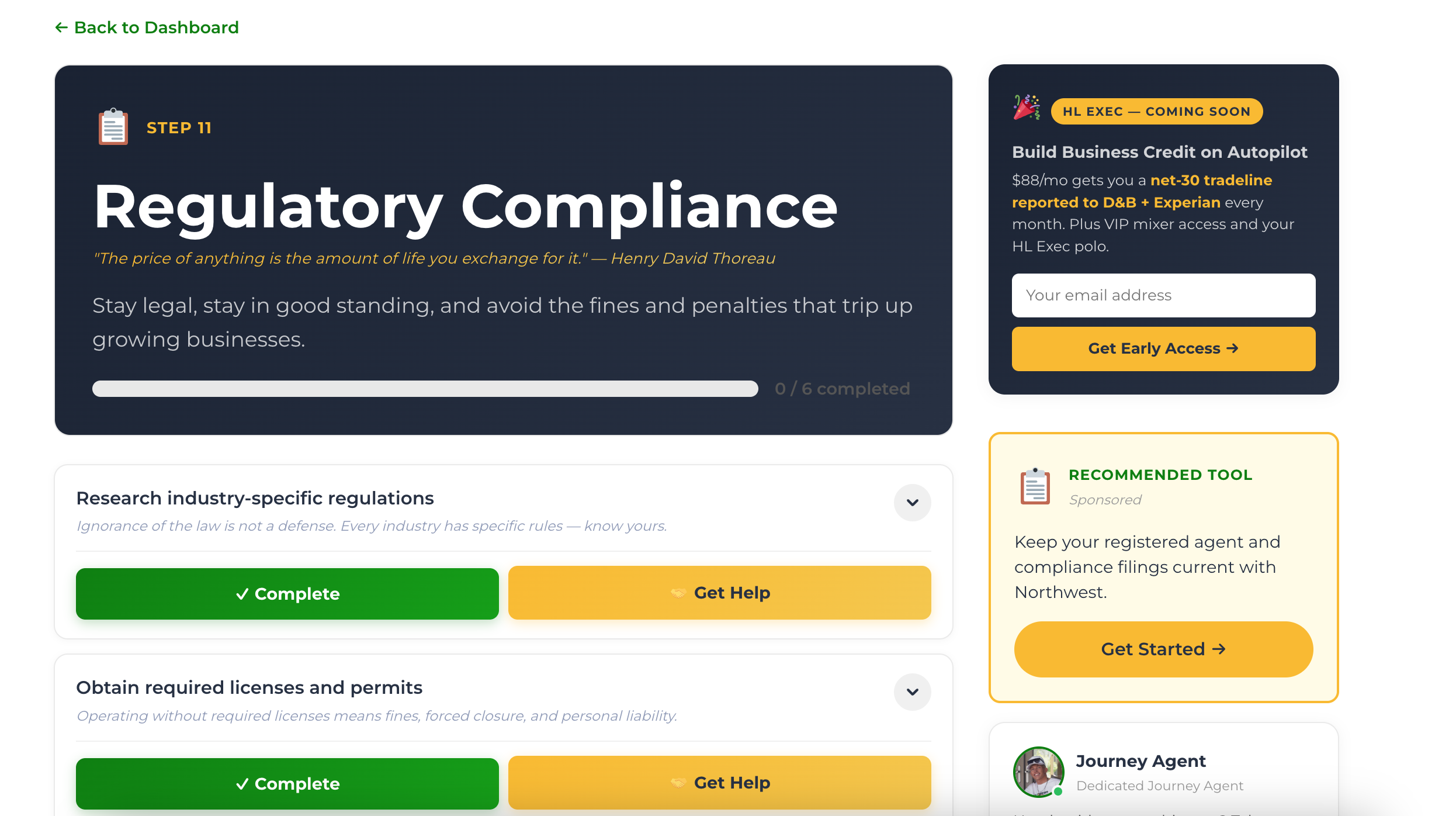
Compliance is the ongoing responsibility to operate within the legal and regulatory framework of your industry, state, and customer base. Licenses, permits, data privacy, accessibility standards, industry-specific regulations: this stage is about ensuring your business can survive scrutiny and is…
Compliance is the stage founders most consistently underestimate until it becomes a crisis. A food business operating without a health permit. A financial services company storing customer data without a compliant privacy policy. A contractor operating in a state that requires licensing without…
Business licenses: most cities and counties require a general business license regardless of industry. Check your local requirements: they are not automatically communicated to you. Industry permits: food service, healthcare, construction, financial services, childcare: each carries specific…
Customer support is the system that turns buyers into advocates. It covers how you handle questions, complaints, refunds, and feedback: and how you build the processes and tools that make that experience consistently excellent as volume grows. Done well, support is a growth engine. Done poorly, it…
Most founders treat customer support as a cost center rather than a revenue driver. The data says otherwise. Customers who have a positive support experience are significantly more likely to repurchase and refer. Customers who have a negative experience do not just leave: they tell people, and in…
Helpdesk: Zendesk for larger teams, Freshdesk for mid-market, Intercom for product-led growth models, Help Scout for small teams. Match the tool to your volume and team structure. Live chat: even a basic chatbot that captures contact information is better than no live chat on a high-intent page.…
Exit strategy is planning for the endgame: and the best time to plan an exit is long before you are ready to exit. Whether you are building to sell, planning to pass the business to a family member, or aiming to distribute dividends indefinitely, the decisions made throughout the previous twelve…
Most founders do not think seriously about exit until they are burned out, an unsolicited offer arrives, or a health event forces their hand. All three are suboptimal times to make a high-stakes financial decision under time pressure. The founder who has spent three years building toward exit…
Valuation methods: revenue multiple (common for SaaS and media businesses), EBITDA multiple (common for service businesses and manufacturing), asset-based valuation (common for asset-heavy businesses). Know which methodology applies to your model and at what ranges businesses like yours actually…
The Business Journey dashboard maps your exact position across all 13 stages. Track your progress, unlock resources for each step, and build with a framework used by thousands of founders at Hustler's Library.

No credit card required · Takes 3 minutes · Personalized to your stage