
Most small business owners spend a surprising amount of time thinking about their competitors. Who just opened down the street. What the other agency is charging. What that other consultant is posting on LinkedIn. And while competitive awareness has its place, there is a far more dangerous threat that almost never makes it onto a strategy whiteboard.
It is not a competitor. It has no logo, no website, and no pitch deck. It does not take your clients, undercut your prices, or outspend you on ads. It is something far more insidious, and it lives inside your own operation: inertia.
Inertia is the force that keeps businesses doing what they have always done, long after the reasons for doing it have expired. It is why the pricing model you set three years ago is still in place. Why the software tool you chose when you had five clients is still running a business with fifty. Why the marketing strategy that worked in year one is still the primary strategy in year four, even though the results have quietly been declining for eighteen months.
Inertia does not announce itself. It masquerades as stability. It feels like “if it ain’t broke, don’t fix it.” And by the time most business owners recognize it for what it is, it has already cost them real revenue, real clients, and real opportunity.
Why Inertia Is More Dangerous Than Competition
When a competitor beats you on price, you know about it. When a competitor wins a client you pitched, there is feedback you can act on. The loss is visible, and visibility creates urgency.
Inertia does not give you that feedback signal. It works silently. It drains your energy, your margins, and your potential without triggering any alarm. The business is not dying; it is just not growing. Revenue is flat, not falling. Clients are fine, just not expanding. The team is busy, just not moving forward.
That is the paradox: inertia feels safe because nothing is obviously wrong. But nothing obviously wrong is not the same as everything being right.
The small businesses that plateau at the same revenue level for two, three, or four years in a row are almost never losing to external competition. They are losing to internal stagnation. The owners who look up one day and wonder why the business feels harder than it used to are often doing the same things the same way, just in a market that has quietly changed around them.
The Three Forms Inertia Takes in a Small Business
Recognizing inertia means knowing what it looks like in practice. It typically shows up in three distinct ways.
1. Process Inertia
This is the most common form. It is the “we’ve always done it this way” approach to running operations. Invoicing, onboarding, communication, delivery: all built around the needs of the business when it was smaller, simpler, or serving different clients. Process inertia is why a 20-person company is still using a spreadsheet that made sense when the team had four people. It is why a client onboarding sequence that takes two weeks could take three days with a minor restructure that nobody has gotten around to.
Process inertia costs money every single day through inefficiency, friction, and the slow leak of client experience quality. For a deeper look at signs your systems have outgrown your growth, this breakdown of when tools stop serving the business is worth the read.
2. Offer Inertia
This is the version of inertia that lives in your product or service lineup. It is the service you keep offering because clients used to ask for it, not because it is still generating real revenue or margin. It is the pricing tier you have not revisited because repricing feels uncomfortable. It is the package you built for a client profile that no longer represents your best customer.
Offer inertia is particularly expensive because it quietly pulls your energy toward low-value work while high-value opportunities go unpursued. Owners caught in this pattern often feel busy but not profitable, which is one of the clearest signals that the offer structure needs a hard look.
3. Mindset Inertia
This is the hardest one to spot because it feels like wisdom. Mindset inertia is the accumulated set of beliefs about what your business can and cannot do, who your client is, what you charge, how big you can get, and how fast you should move. These beliefs were often formed in the early days, shaped by early setbacks, early wins, and early limitations that no longer apply.
The owner who capped their prices at a rate that felt “fair” two years ago and has never revisited it. The business that has not added a new service category because the owner decided they were “not that type of company” before they had the resources to be. Mindset inertia is where the real ceiling lives, and it rarely looks like a limitation from the inside.
How to Diagnose Inertia in Your Own Business
The most effective tool for surfacing inertia is a simple audit question applied to every part of your operation: “If we were starting this from scratch today, would we do it this way?”
Go through your processes, your offer lineup, your pricing, your team structure, your marketing channels, and your client mix. For each, ask the question honestly. Not “does this work?” but “is this the best approach we would choose with what we know now?”
Most business owners who run this exercise come away with a list of three to eight things they would change immediately if they had built the business today. That list is your inertia map. It is also your growth plan.
A useful complement to this exercise is a regular business review practice. A well-structured quarterly review is one of the most reliable ways to catch inertia early, before it compounds into a real problem.
Breaking Inertia Without Breaking What Works
The goal is not to tear everything down and start over. It is to distinguish between the things that are working and still make sense, and the things that are simply still in place because nobody has gotten around to changing them.
There is a useful framework here: treat every system, offer, and assumption as if it has an expiration date. Not because things stop working eventually, but because the discipline of reviewing them regularly keeps you ahead of the decay curve. A pricing model reviewed annually and confirmed is a different thing from a pricing model that has never been reviewed and happens to still be in place.
The SBA recommends that small businesses conduct a formal business review at least once per year, examining not just financial performance but operational structure and market positioning. This kind of structured review is one of the simplest ways to interrupt the inertia cycle before it calcifies into something harder to change. Learn more at SBA.gov’s business management resources.
When you do find areas where inertia has taken hold, the approach that works best is not a sweeping overhaul. It is a targeted experiment. Change one thing, measure the result, then decide. This is how the most adaptive small business owners stay ahead: not by reinventing constantly, but by running small, deliberate tests that prevent any single assumption from going unchallenged for too long.
The Competitive Advantage Inside the Question
Here is the counterintuitive part: most of your competitors are not fighting inertia either. They are caught in the same trap, doing what they have always done, not because it is optimal, but because changing is uncomfortable and nothing has forced the issue.
That means the business that builds a regular habit of auditing its own assumptions and systems has a genuine structural advantage over almost every other player in its market. Not because of a better product, a bigger marketing budget, or a stronger brand, but because of a willingness to ask hard questions that most owners avoid.
The businesses that are still relevant and growing in ten years will not be the ones that found the best strategy in year one and stuck to it. They will be the ones that found a good strategy, made it work, and then had the discipline to revisit it, update it, and replace it when the time came.
That discipline starts with recognizing that inertia is always in the room, quietly defending the status quo. Your job is not to let it win.
Want more frameworks like this delivered straight to your inbox? Join thousands of small business owners who use Hustler’s Library to sharpen their thinking and grow their operations. Join free here.
Ready to Know Where You Stand?
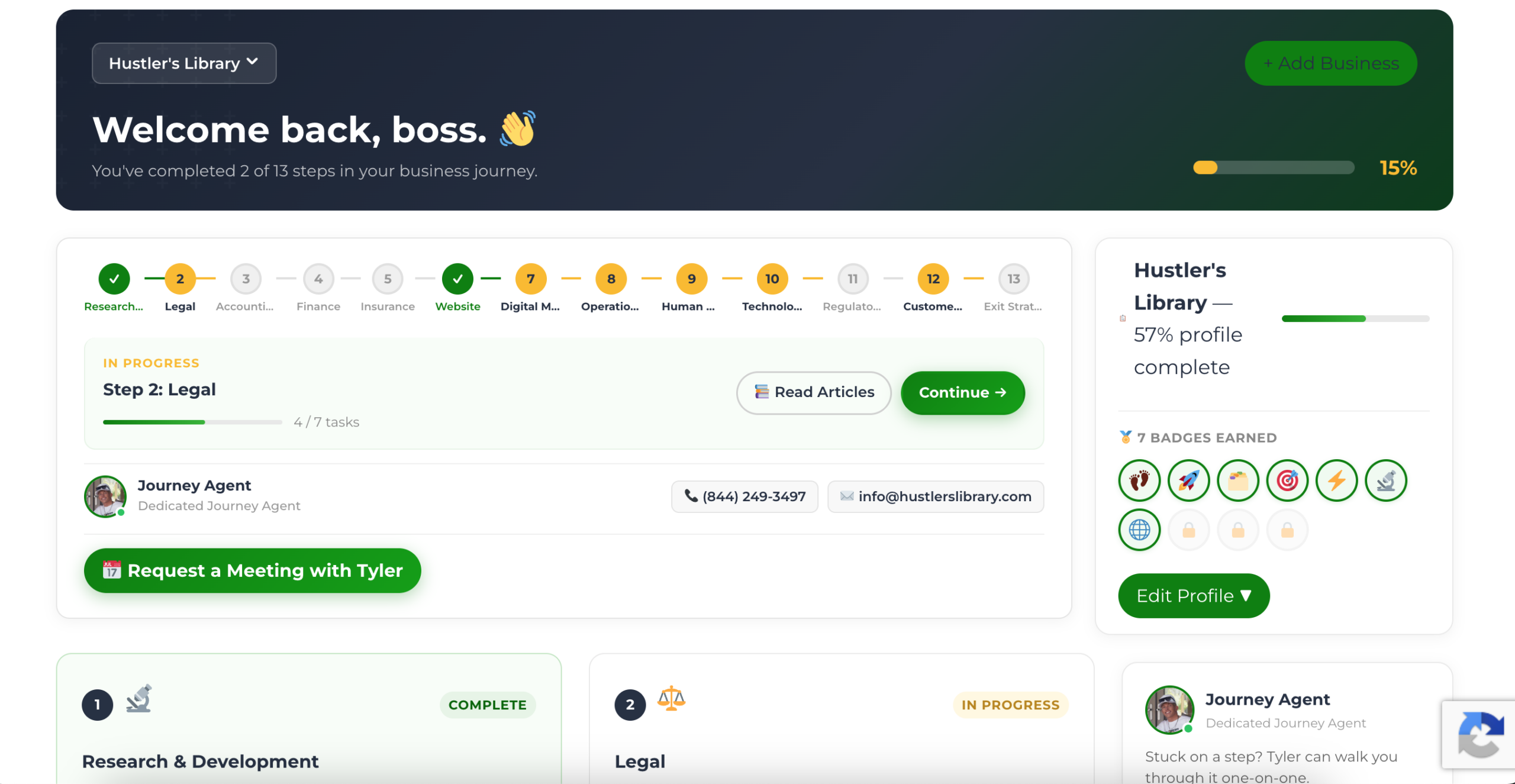
The Business Journey dashboard maps your exact position across all 13 stages. Track your progress, unlock resources for each step, and build with a framework used by thousands of founders at Hustler's Library.
No credit card required · Takes 3 minutes · Personalized to your stage